
2025 Artistic Program
2025 Artistic Program
Serwah Attafuah, Mostafa Azimitabar, Billy Bain, Gosha Heldtz, Jacquie Meng & Heath Nock
You’re Welcome?
Curated by Billy Bain
24 January - 27 March

Billy Bain, SOVEREIGN SOLDIER #1, 2023, earthenware with underglaze, glaze and gold lustre, 1200 × 480mm, installation view. Courtesy of the Elliott Eyes Collection. Photography by Jessica Maurer.
Curatorial Statement
What does it mean to be welcome in ‘Australia’?
Curated by Dharug artist Billy Bain, You’re Welcome? explores the ways in which a group of young Sydney-based artists form, express, and interrogate ideas of what it means to be welcome. Through non-traditional, figurative portraiture, these artists navigate their own multicultural identities and create both physical and digital space for community, despite an often hostile and unwelcoming wider Australian consciousness.
Running concurrently with Invasion Day and The University of Sydney’s Welcome Week, You’re Welcome? celebrates and platforms these artist’s unique stories and perspectives — from the political to the surreal and humorous.
Fei Gao
The Path
19 - 20 February

The Path by Fei Gao, 2025. Performance still by Michael Cole, courtesy of USU.
Artist Statement
The Path isa series of performances created by Fei Gao, originally commissioned by Parramatta Artists Studios, which bring to life the diverse migration journeys of five friends, taking place in the context of You’re Welcome? during the University of Sydney's Welcome Week.
Each of the five performers in The Path are adorned in striking armor, created during intimate interviews that informed each of the individual costume designs. These costumes, rendered in vivid hues of Blue, Green, Orange, Purple, and Black, weave personal and poetic stories of migration into their very fabric. Through collaborative workshops, the performers have crafted unique movements that echo their individual journeys.
The Path comes together in a powerful moment where the five characters’ separate paths converge, symbolising a shared transformation. As they traverse the open field, they enact a compelling search for belonging and connection. This search resolves in a celebratory dance—a tribute to the bonds and communities that migrants forge to support one another in the face of adversity. This finale encapsulates a process of transformation, resilience, and symbolises the enduring human quest for connection.
Ellen Dahl and poet Hannah Jenkins
On Water and Time / a glacier leaves a deep cut
10 April - 6 May

Left: Ellen Dahl, a glacier leaves a deep cut, 2025, neon, 1600 x 156mm. Right: Ellen Dahl, The Edge of Time 1, 2024, archival pigment print on fibre rag, white hardwood frame with museum glazing, 1000 x 700mm. Images by Jessica Maurer.
Artist Statement
Dark calculations,
I trace them along the slope of the horizon,
the measurement of time is simply the surface of the water,
rotating away from the sun.
On Water and Time / a glacier leaves a deep cut brings together new and established strands of Ellen Dahl’s artistic practice and her ongoing creative collaboration with poet Hannah Jenkins.
Working in response to two specific sites, Nordenskiöld Glacier in Svalbard and Jostedalsbreen in Norway, Dahl’s expanded photographic practice—encompassing scale, materiality, still-motion and sound—traces the marks left by the slow, inexorable movements of ice as it carves and erases in equal measure.
As new snow and ice reform the glaciers, they embed information on the chemical composition of the atmosphere, creating unique high-resolution archives of the planet’s climate. Ice cores extracted from glaciers provide critical data for tracing environmental changes, but as glaciers melt more than the new snow and ice they attain each winter, these frozen records of environmental and climatic history turn into meltwater.
On Water and Time / a glacier leaves a deep cut considers how these natural archives shift, dissolve, and reveal the impact of human activity on the environment. Photography, video, sound and poetry combine as instruments not of documentation, but of translation: ephemeral whispers accrete into lasting impressions, and immense geological time scales are condensed into the fleeting perception of the present.
Miška Mandić
Residue
Premiered at Verge 26 May - 6 June
Screening online 10 June - 10 September

Miška Mandić, Residue, 2024, video still. Image courtesy of the artist.
Artist Statement
In Residue, the geological time held by all the minerals inside a mobile phone is visualised alongside the fruiting, sporing and decomposing time of fungi and soil. This is a troubled sense of stillness — the iPhone, like the lemon, like Angela, like the film crew, collide with people, animals, geological and tectonic movements, cameras, computers, ideologies, and visions of nationhood and time. Residue reconsiders what is regarded as important in the cinematic traditions of Western modernity and how in the gaps of its vision there are textures worth noticing.
Sidney McMahon
Sixty-nine
26 June – 15 August

Sidney McMahon, Sixty-nine, 2025, installation view. Photography by Jessica Maurer.
Artist Statement
Sixty-nine is an immersive sculptural exploration of the symbolic and emotional terrain of the number 69 as a cycle of life, death, queerness, and intimacy. Anchored in the architecture of the home, the work navigates domestic spaces as sites of eroticism, grief, and repetition.
Through video work and layered sculptural forms, the exhibition evokes the five stages of grief - denial, anger, bargaining, depression, and acceptance - as nonlinear, looping states.
Tender, raw, and unsettling, it considers how care and rupture coexist, how desire and mourning blur, and how queer intimacy reclaims space within familiar cycles of loss, pleasure, and transformation.
2025 USU Creative Awards
25 August - 19 September

Left to right: Jingru Mai (Moira), The Monster in the House, 2025. Bonnie Huang, lost and found crucifix, 2024. Lauren Maccoll, Adam and Steve / The Apple Theory, 2025. Estelle Yoon, 누구의 기억 (Second Exposure), 2025. Photography by Jessica Maurer.
Exhibition Statement
Open to all students at the University of Sydney (USyd), the annual USU Creative Awards is Australia’s largest university student union creative prize, highlighting the very best of visual arts, short film, writing and music from our student body.
Platforming the voices of USyd’s emerging creatives, the 2025 USU Creative Awards showcases works engaged with a vast range of themes, including queer identity, representations of femininity, grief and catharsis, the quotidian, and memory.
Although varying in subject matter, many of the works are grounded in personal experience and navigate socio-political matters pertinent to young people within contemporary society. Featuring finalists across all four categories, the Creative Awards sheds light on the experiences and perspectives of USyd’s student community.
Chris Dolman
This won’t last
2 - 31 October
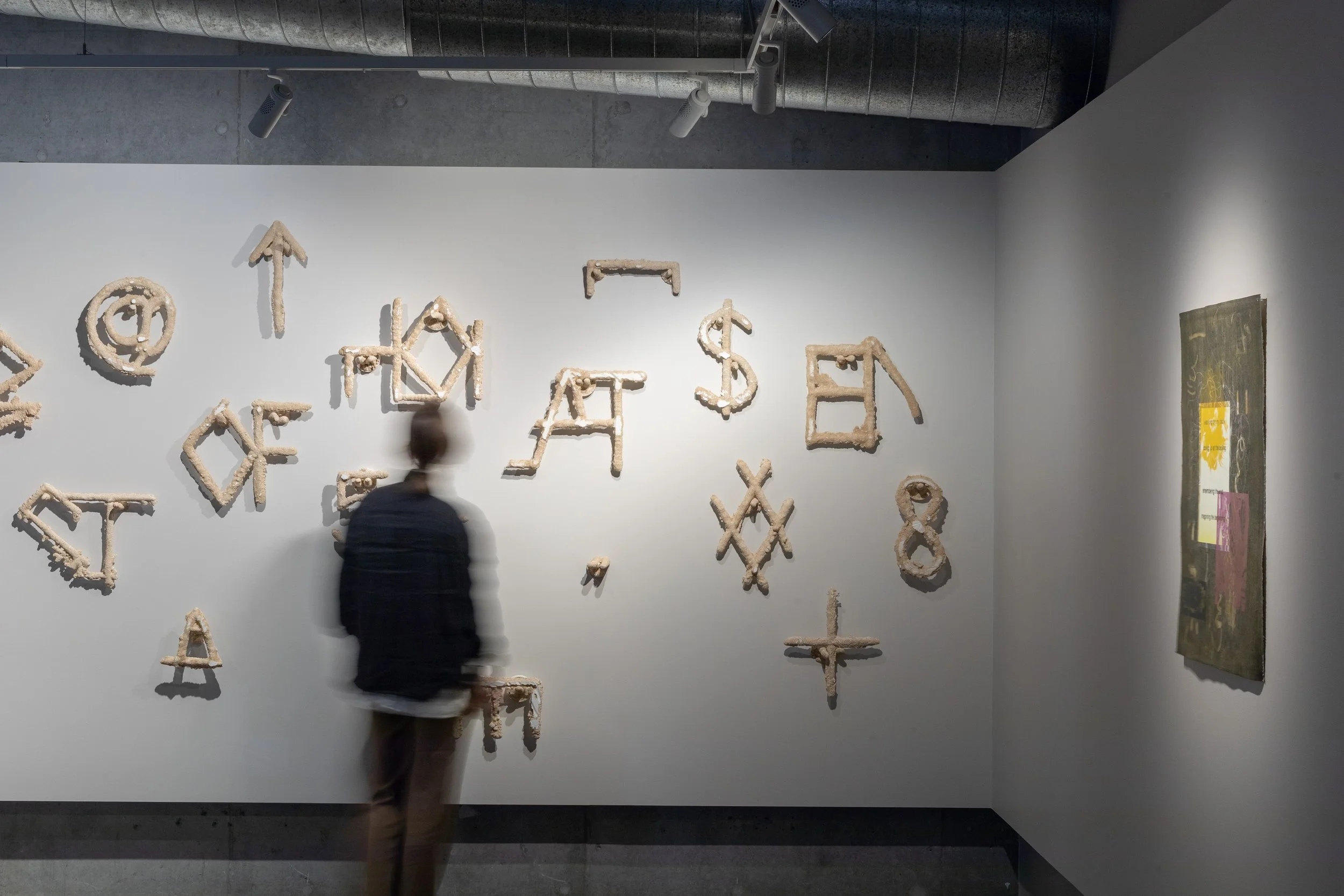
Chris Dolman, This won’t last, 2025, installation view. Photography by Jessica Maurer.
Artist Statement
This won’t last is an installation that takes on ideas of the contemporary ruin to explore impermanence, disembodiment, failure, and decay.
The exhibition in a broad sense is a response to questions I have pondered lately;
Can a ruin ever be complete, or is its essence always in the process of becoming? Do ideas shape the world more through their clarity or their ambiguity? Is a ruin a mask, or a memory unravelling?
Through hand building and sandcasting, layered monoprints and soundscapes, disguised office furniture, field recordings, and videos on phones, the work draws on fragments of personal history, speaks to the artist studio as a site of ruin, and speculates on a collective dystopic future that is quickly closing in.
Eddie Abd
folded in
10 November - 12 December
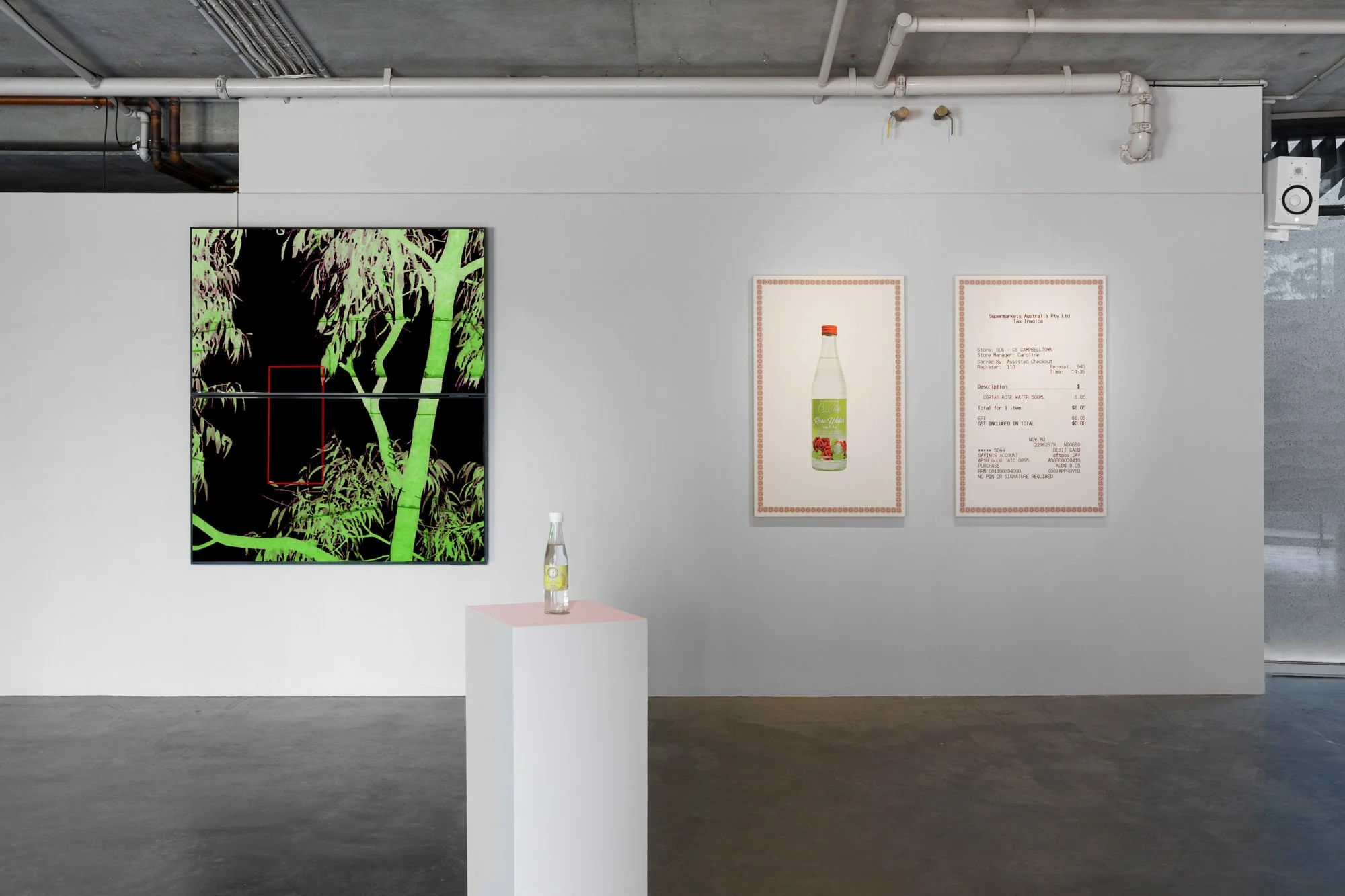
Left to right: Eddie Abd, 3999, 2025, 2-channel video, no sound, 3 mins, looped. Filmed in Lebanon and on Dharug and Gundungarra Country; Eddie Abd, holy water, 2025, fabric print stretched on canvas, 750 × 120mm, with eucalyptus water (bottled) on plinth. Photography by Jessica Maurer.
Artist Statement
folded in is an exploration of complicity through camouflage and collage. It marks a moment of heightened awareness of our individual and collective entanglements with systems that are scaffolded by historical and present injustices.
Drawn from a speech by Indian scholar Gayatri Spivak, the expression ‘folded in’ became an entry point into self-reflection beyond the notion of guilt. The works in this exhibition are borne out of personal reckonings within myself and family and have been shaped by my ongoing conversations with colleagues, most notably Dharug artist and educator Leanne Tobin.
folded in starts a process of acknowledgment and conversation framed by personal history, the politics of the day and diasporic art making within the colony.