
How to dismantle the world (and still feel good about yourself in the morning)
Cybele Cox, Madi Feist, Isabella Hone-Saunders, Barrie Goddard, Emma Pham, Nick Santoro
How to dismantle the world (and still feel good about yourself in the morning)
5 February - 27 March, 2026
Thursday 5 February: Exhibition Launch
Wednesday 18-20 February: Verge X PULP at USU Welcome Fest
Thursday 5 March: The Great Post-Apocalyptic Debate
Wednesday 11 March: Echoes: How to dismantle the world…
Wednesday 18 March: In Conversation
Accessibility
Audio descriptions for How to dismantle the world (and still feel good about yourself in the morning) have been co-designed by Sarah Empey and Anthia Balis, and aim to provide enhanced accessibility for all visitors, including those who are blind or have low vision. These can be accessed in the gallery via a series of QR codes located next to a number of the artworks in the exhibition. Verge encourages patrons to bring their own headphones.
Tactile floor markings are also provided in the gallery for visitors using white canes.
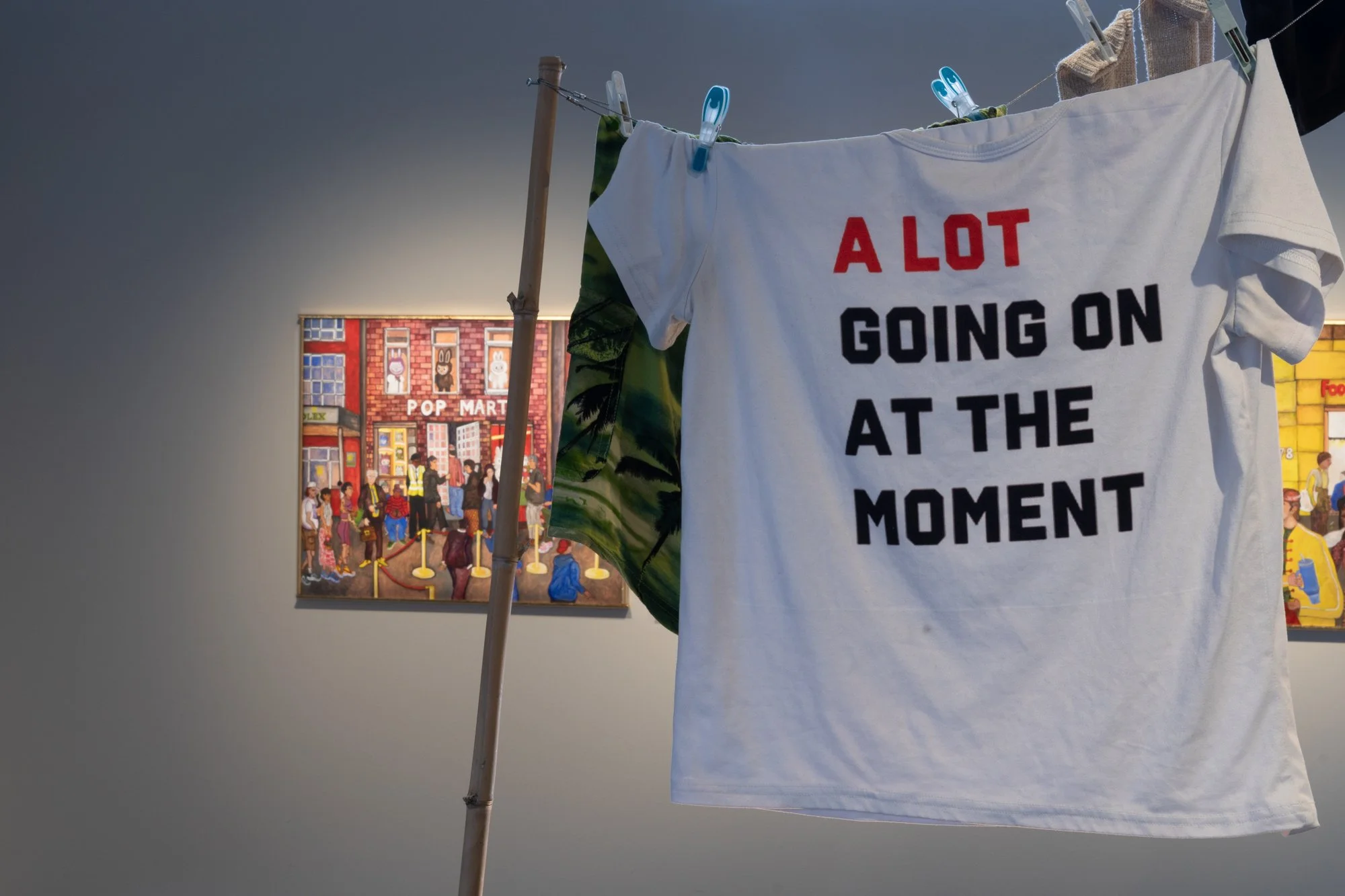
How to dismantle the world (and still feel good about yourself in the morning), 2026, installation view. Photography by Jessica Maurer.
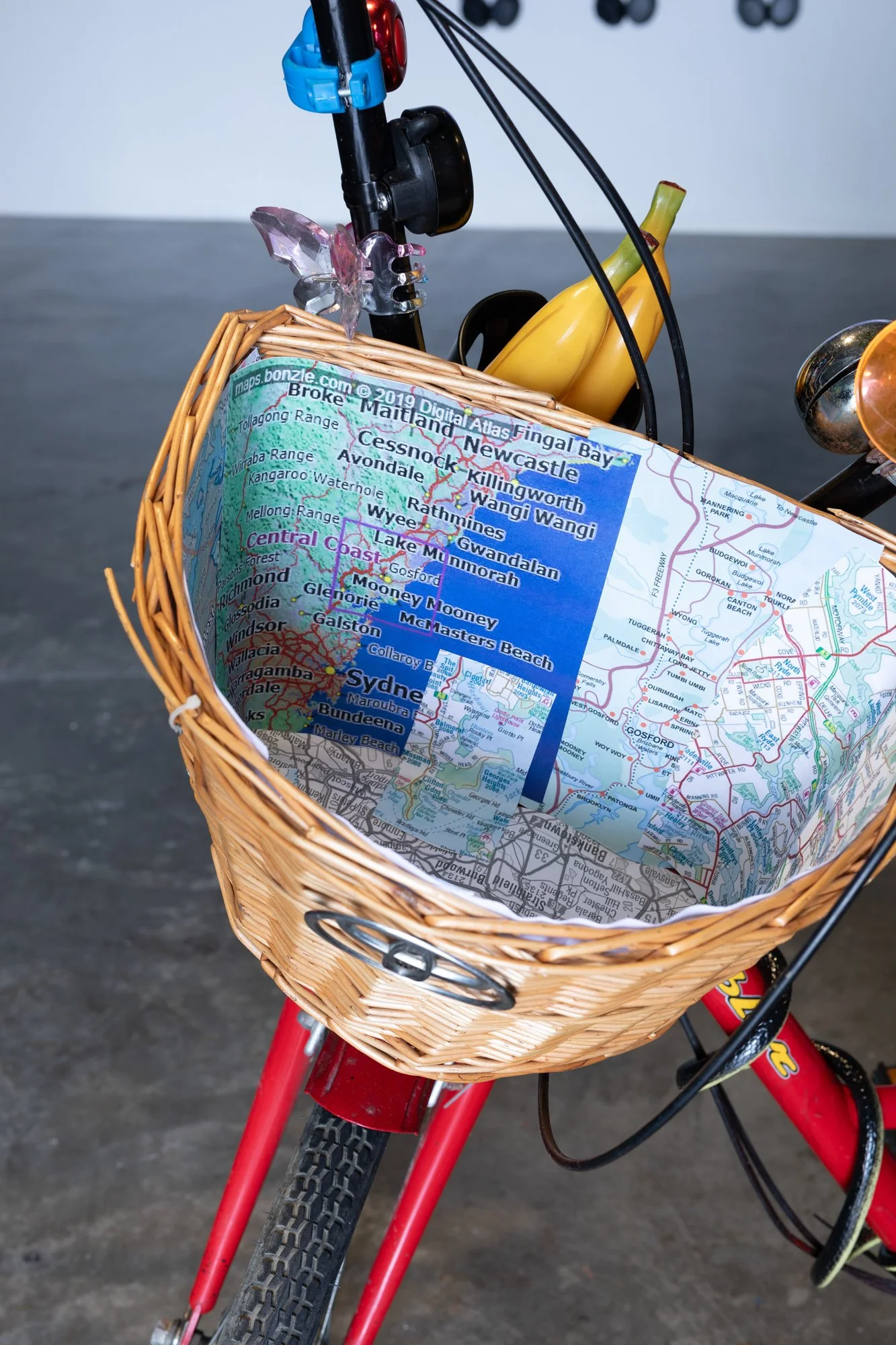
Madi Feist, The Snail, 2026, INDI Rambler tricycle, found furniture and household objects, wood, metal hardware, bamboo, rachet straps, plants, pvc pipe, rope, assorted textiles, castor wheels, plastic, lamps, metal, shells, dimensions variable. Photography by Jessica Maurer.
Exhibition text
Can you feel it; the sticky malaise in the air? The world is going nowhere promising, fast. Is it possible to turn things around…by tearing everything apart?
How to dismantle the world (and still feel good about yourself in the morning) [1] invites artists to offer contradictions to an age of crisis. The exhibition explores alternatives to dominant capitalist systems and ideologies, without reproducing the same oppressive visual and rhetorical strategies associated with political strongmen, industrial despots, and media influencers. Presenting audiences with ideas about how one might unfasten and disassemble social, political, and environmental structures, this exhibition suggests how one might envision a different world, even though we may not yet know its form.
How to dismantle the world... features artists Cybele Cox, Madi Feist, Barrie Goddard, Isabella Hone-Saunders, Emma Pham, and Nick Santoro. Each artist considered the challenge above in distinct ways, employing a range of approaches, including but not limited to recruiting avatars, next-generation communities, and celestial and earthly beings that are ambiguous in form and identity. The result is a collective of multidisciplinary works that are whimsical, humorous, and earnest, spanning mediums including painting, sculpture, site-specific installation and digital platforms.
Emma Pham
Emma Pham’s The Decay of the Great Digital Dream (2026) is a three-part video work depicting Pham’s cyber avatar, Aero_Girl99, as they navigate their relationship with internet culture. Referencing early 2000s internet style ‘Frutiger Aero,’ Pham reflects upon early utopian visions of the internet in comparison with the current ‘digital wasteland’ which we find ourselves in, entangled with ‘enshittified’ contemporary networked systems.
Pham considers how we might reconcile our desires for an internet that works for us, while engaged with a digital world which ultimately doesn’t serve us. How can we hold onto our utopian visions, our conceptions of a ‘lost future,’ as a means of moving forward? By quoting Black Panther member Huey P Newtown in her work, ‘the spirit of the people is greater than man’s technology’ [2], Pham answers her own question - society can work together to address lost futures and dreams. The future is still in our hands, and the future is still becoming.
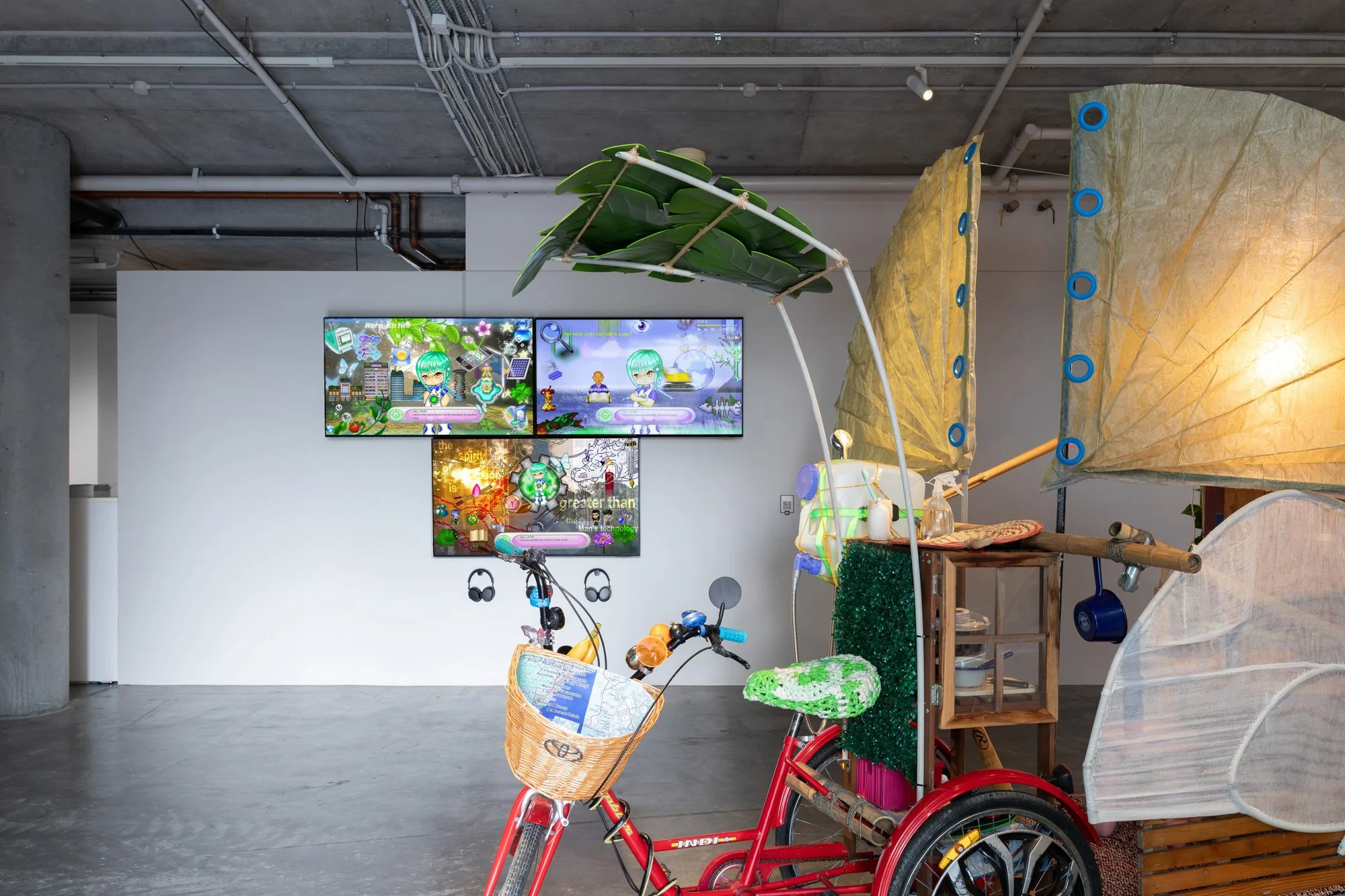
Back: Emma Pham, Decay of the Great Digital Dream, 2026, digital videos, 7min (looped).
Front: Madi Feist, The Snail, 2026, INDI Rambler tricycle, found furniture and household objects, wood, metal hardware, bamboo, rachet straps, plants, pvc pipe, rope, assorted textiles, castor wheels, plastic, lamps, metal, shells, dimensions variable.
Photography by Jessica Maurer.
Isabella Hone-Saunders
Naarm-based artist Isabella Hone-Saunders’ community collaboration invites a group of primary school children to consider the concept of ‘hope,’ empowering them to address a world shaped by political and ecological anxiety. Staged as a two-channel video work with a soundtrack composed by Daniel Jenatsch Hope floats (2026) introduces these children to the manifesto form, working in groups to create a declaration intended to inspire change. The work foregrounds the relationship between personal and communal wellness, with Hone-Saunders arguing that it is here that hope lies.
The simplicity of the children's ideas, such as those centred around dogs – for example, in contemplating the morality of a pet - might appear naive. However, these ideas reflect authenticity and sincerity, and are deeply relational, revealing a deconstruction of the world through connection, care, and collective agency.
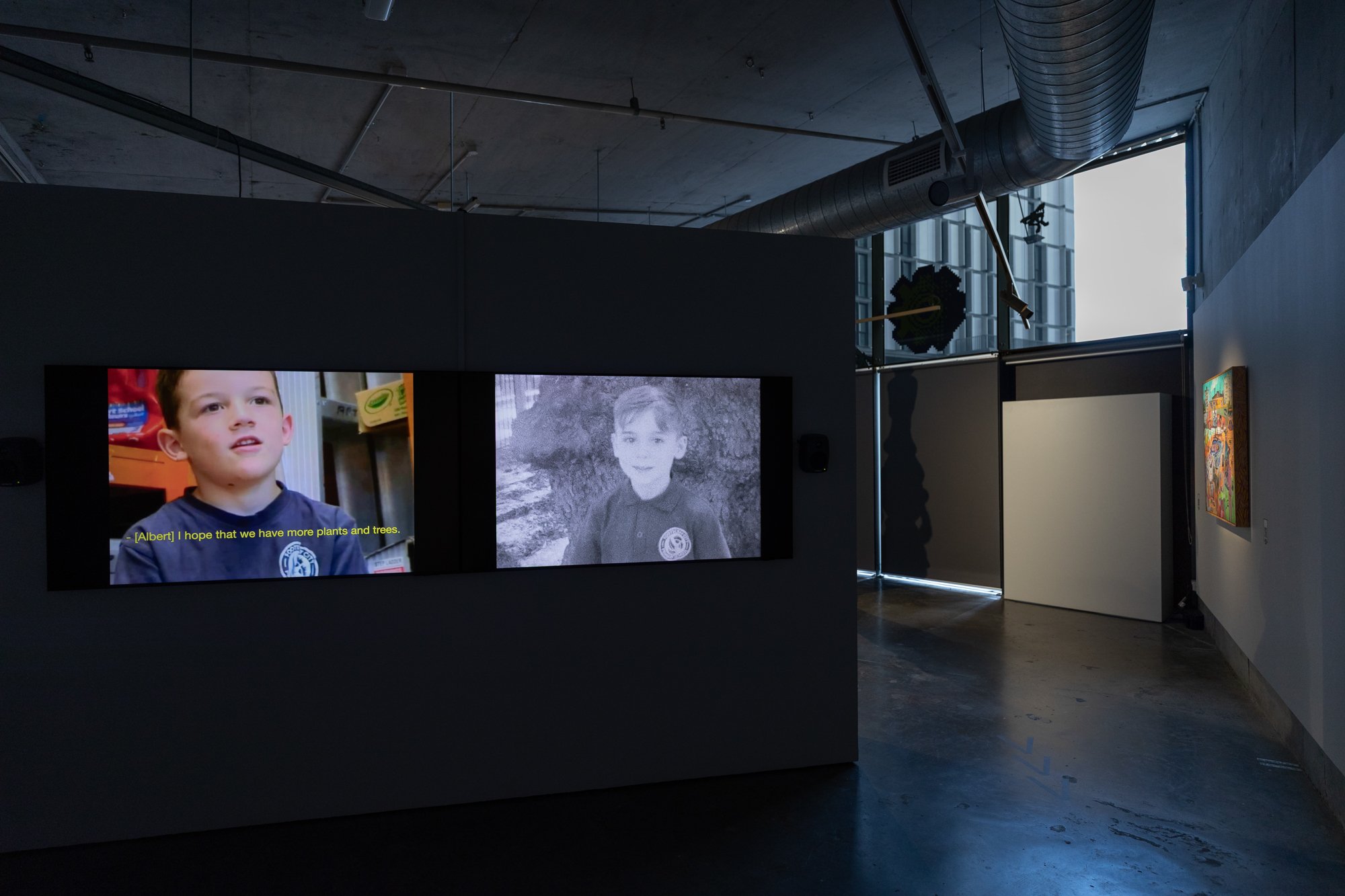
Isabella Hone-Saunders, Hope floats, 2026. Two-channel video work, 15 min 30 sec, colour and black and white, digitised Sony hi8 tape and Super 8. Scored by Daniel Jenatsch. Photography by Jessica Maurer.
Nick Santoro
Nick Santoro’s Line Series presents four scenes of commerce that one might come across in the Sydney CBD. The series comprises four acrylic paintings titled The Bread Line (2025), The Sneaker Line (2026), The Gold Line (2026) and The Labubu Line (2026). Each depicts a conglomeration of branded humans and things, appearing ordered yet underlined by chaos, with figures eager to purchase luxury goods, safe-haven assets, and trendy commodities.
In doing so, Santoro points to the absurdity of overconsumption and, in considering this exhibition's rationale, suggests the acceleration of overindulgence to expose capitalism’s fragility, and tear current structures apart, paradoxically pointing towards societal change for the better.
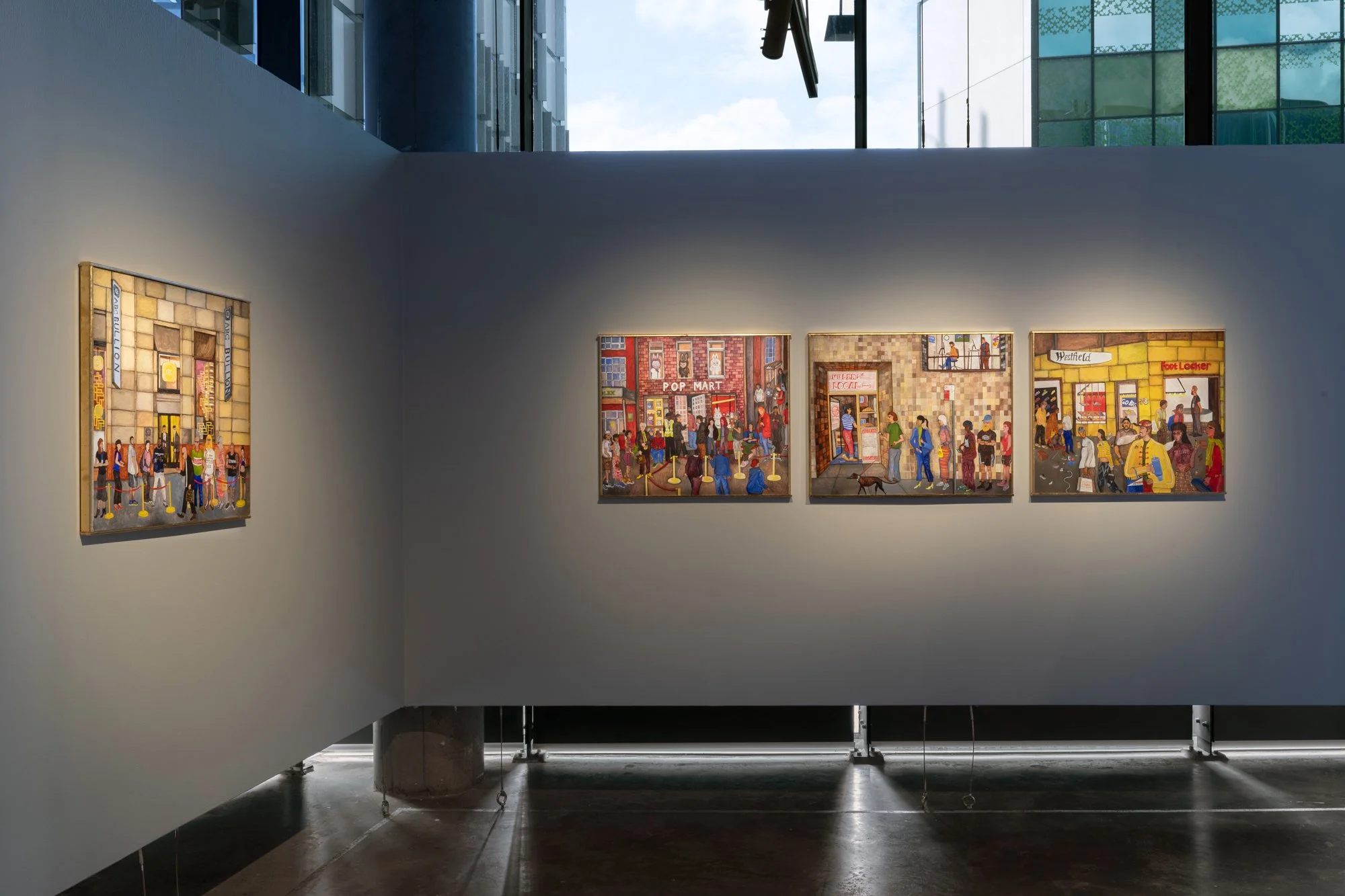
Left to right: Nick Santoro, The gold line, 2026, acrylic on board, 610 x 665mm; The Labubu line, 2026, acrylic on board, 605 x 705mm; The bread line, 2025, acrylic on canvas, 740 x 590 mm; The sneaker line, 2026, acrylic on canvas, 605 x 705mm. Photography by Jessica Maurer.
Madi Feist
Madi Feist’s The Snail (2026) demonstrates a post-apocalyptic lifestyle grounded in self-reliance and scant resources. Countering Santoro’s depiction of overconsumption, the work is an off-grid mobile home composed of a tricycle and trailers, inhabited by an anonymous figure who could be either a snail or a snail enthusiast.
The assemblage resists homogeneity, combining peculiarity with practicality. Rising from the rear of the rider’s seat is a substantial wooden structure held together with recycled bamboo beams, rope, and sticky tape. The interior of the home has a table, stool, and shelves stocked with random domestic objects. With good nature, Feist suggests that it is possible to live frugally while still meeting a desire for creature comforts.
Although nomadic and solitary, the inhabitant of the snail seeks re-connection and personal growth, hinted at by the presence of self-help books. The desire for companionship and the construction of an organised dwelling suggests that dismantling dominant structures may occur through a reconsideration of intelligence systems of the more-than-human.
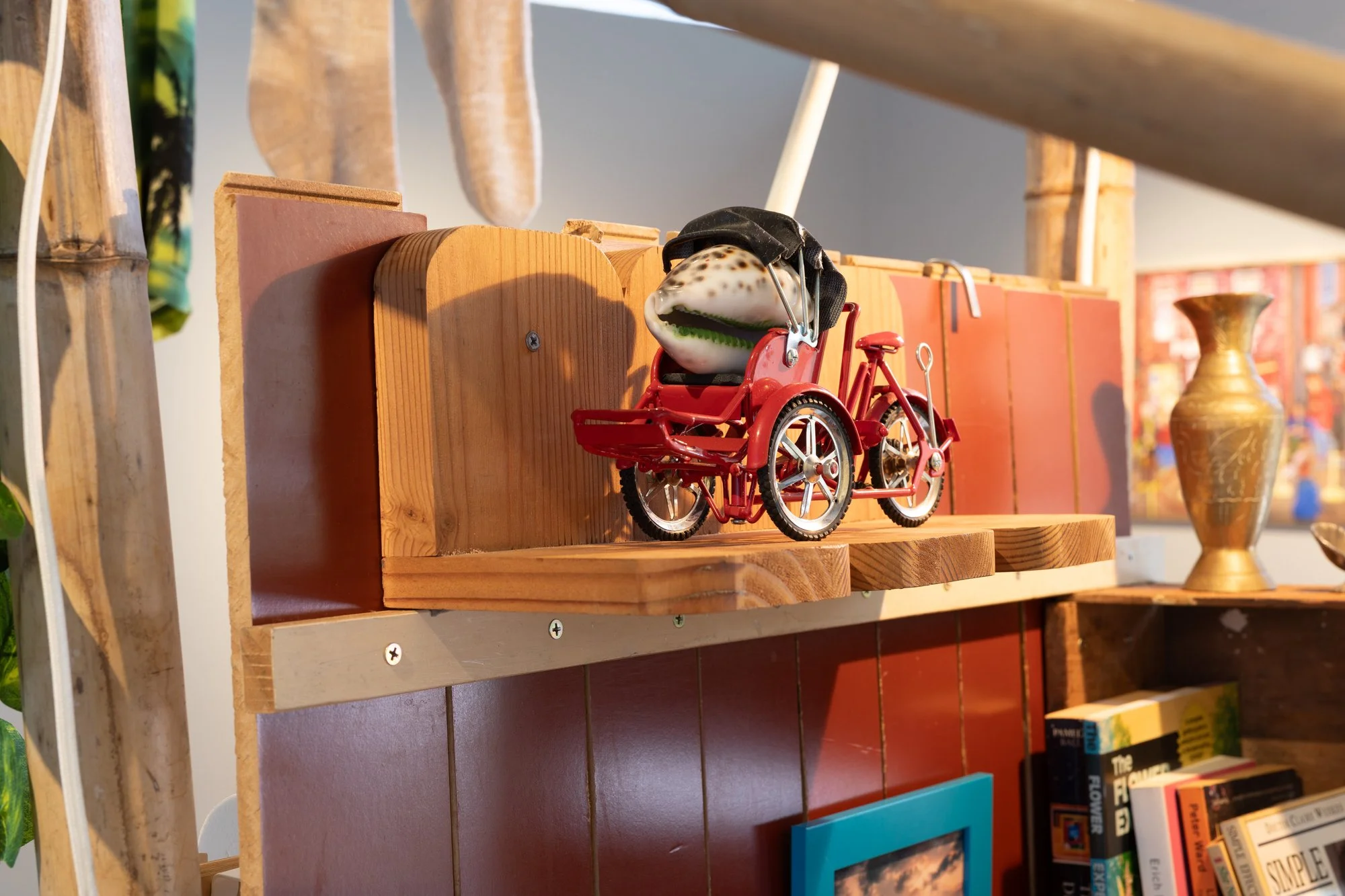
Madi Feist, The Snail (detail), 2026, INDI Rambler tricycle, found furniture and household objects, wood, metal hardware, bamboo, rachet straps, plants, pvc pipe, rope, assorted textiles, castor wheels, plastic, lamps, metal, shells, dimensions variable. Photography by Jessica Maurer.
Cybele Cox
Cybele Cox’s sculptures offer an imagining of new societal systems founded on symbolism and folklore. She merges abstracted and literal representations of biological and celestial beings alongside utilitarian objects in large-scale, totem-like pillars. Cox’s sculptures operate as time-travellers, collecting ideas and forms across multiple artistic and philosophical periods, resisting fixed or predetermined identities imposed upon individuals in contemporary society.
Red Shoes Vanitas (2019) references the Baroque period through the use of seventeenth-century symbolism, such as the skull to represent death and mortality, and fabric to heighten theatricality. Reference to Hans Christian Andersen’s tale The Red Shoes is included - not as a warning (as originally intended) but as an encouragement to break taboos around the body and desire.
In Cosmic Tower and Moonfaces (2019), constellation forms, moon faces, suns, stars, and serpents invoke a cosmological consciousness. Cox invites viewers to follow her works’ form, to unstick and unstack themselves, then reassemble piece by piece, symbolising a “re-flowering” that gestures towards a new feminist order grounded in interconnection.
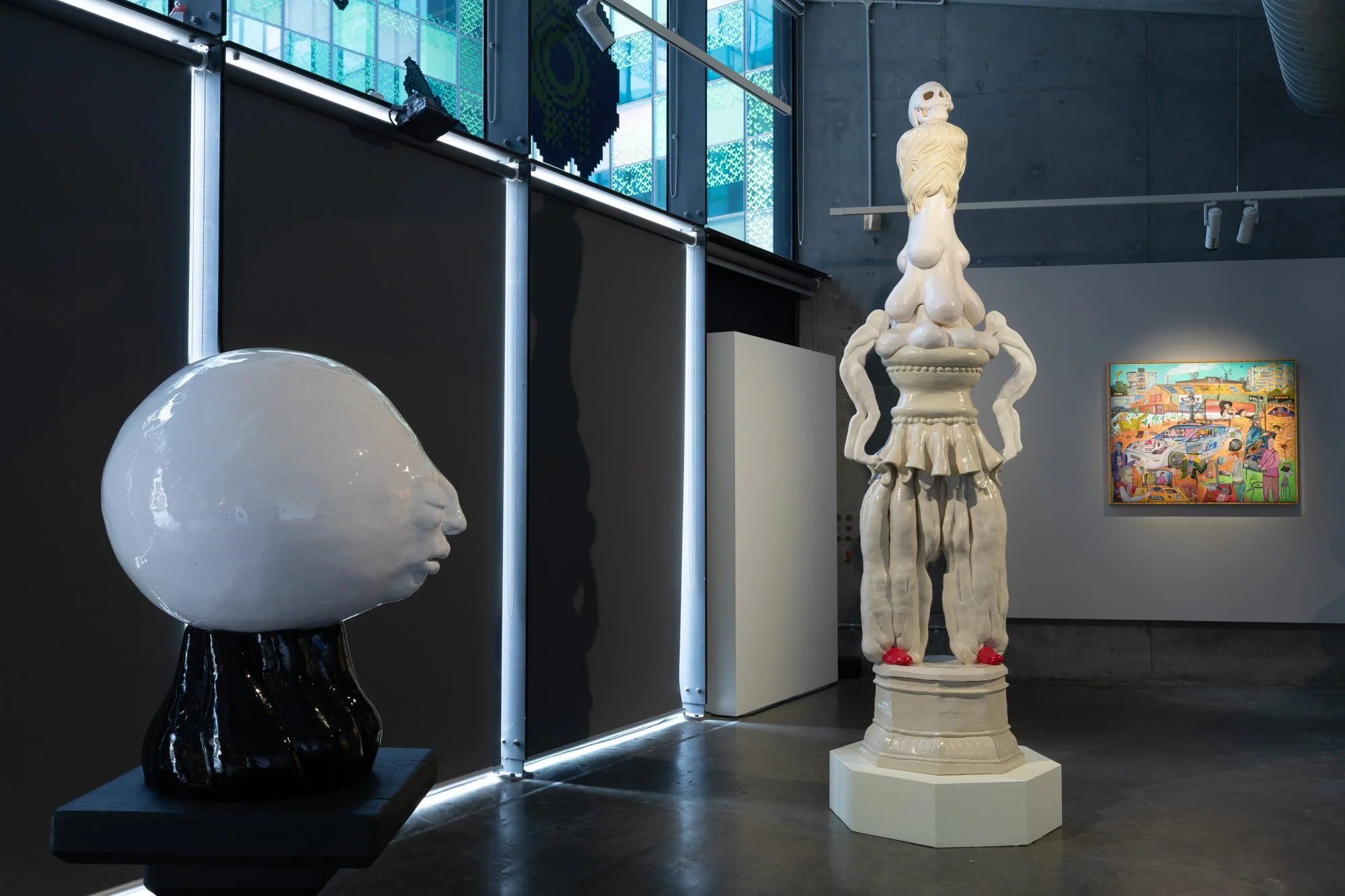
Left & centre: Cybele Cox, Moonfaces, 2019, Hand built glazed earthenware, 1300 x 1600 x 300mm; Red Shoes Vanitas, 2022, hand built ceramic, gesso, acrylic, epoxy, 2200 x 400 x 400mm.
Right: Nick Santoro, The day the crypto crashed, 2023, acrylic on canvas, 840 x 1040mm.
Photography by Jessica Maurer.
Barrie Goddard
Barrie Goddard’s Solar Split (1970) introduces a historical counterpoint to the rest of the works in the exhibition. Solar Split is hung in a diamond-shaped format, allowing the image to float free from gravity. From the canon of hard-edge abstraction, the work favours economy of line and form over expression, offering a sense of order amidst contemporary chaos.
From his Space Series (1969–71), the work reflects Goddard’s exploration of ideas surrounding the Space Race, moonwalking, science fiction, antimatter, and astrophysics, suggesting alternative worlds to our own. Solar Split acts as a companion piece, a friend from the past in dialogue with present anxieties. Curated into How to dismantle... to evoke nostalgia, it reassures without denying uncertainty.
In a world that feels perpetually on the brink, How to dismantle... invites us to listen more closely to the quiet gestures, the speculative futures, and the possibility that something gentler might still undo what has been built loudly. The exhibition hopes to inspire a reassessment of the current trajectory of earthly existence. Artists suggest that this current downward spiral may not be entirely negative...perhaps we can spiral so far that those in power, and the world as we currently know it, loses control. We can envision a positive dismantling of the world.
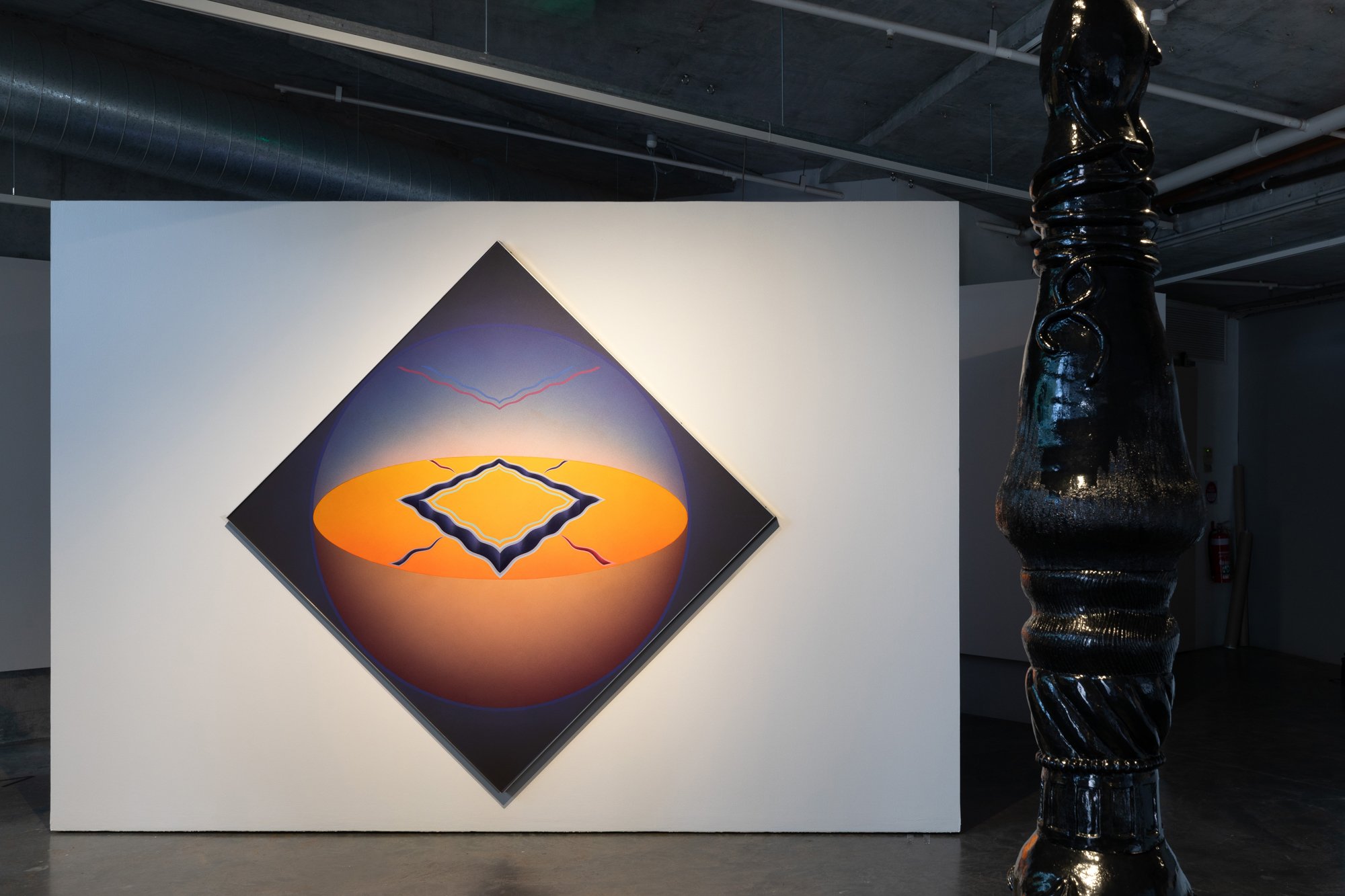
Left: Barrie Goddard, Solar Split, 1970, synthetic polymer paint on canvas, 2160 x 2155mm.
Right: Cybele Cox, Cosmic Tower (Constellation), 2019, hand built glazed earthenware, 2200 x 450 x 450mm.
Photography by Jessica Maurer.
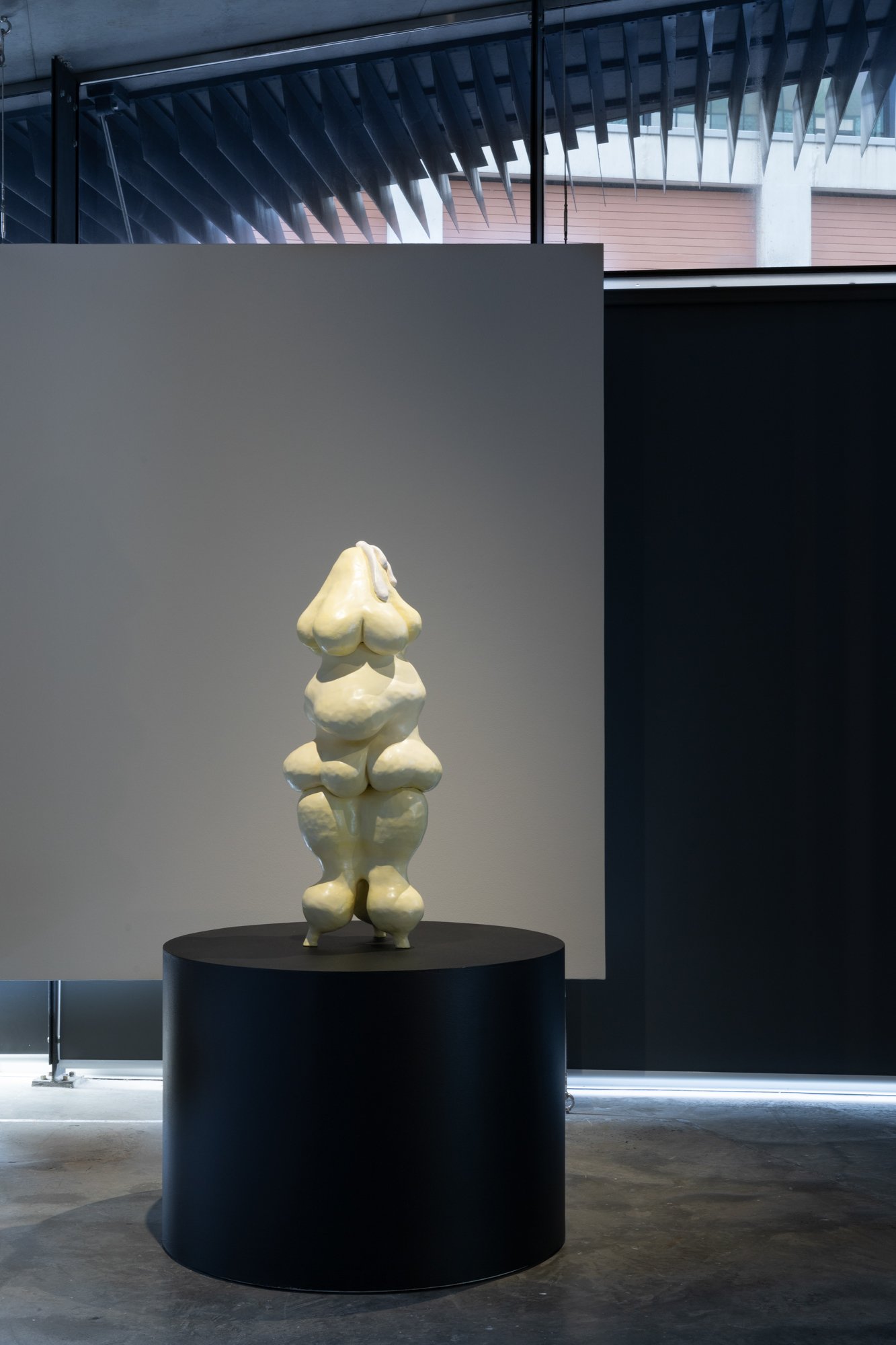
Cybele Cox, Tit Tower, 2021, hand built glazed earthenware, 950 x 400 x 400mm. Photography by Jessica Maurer.
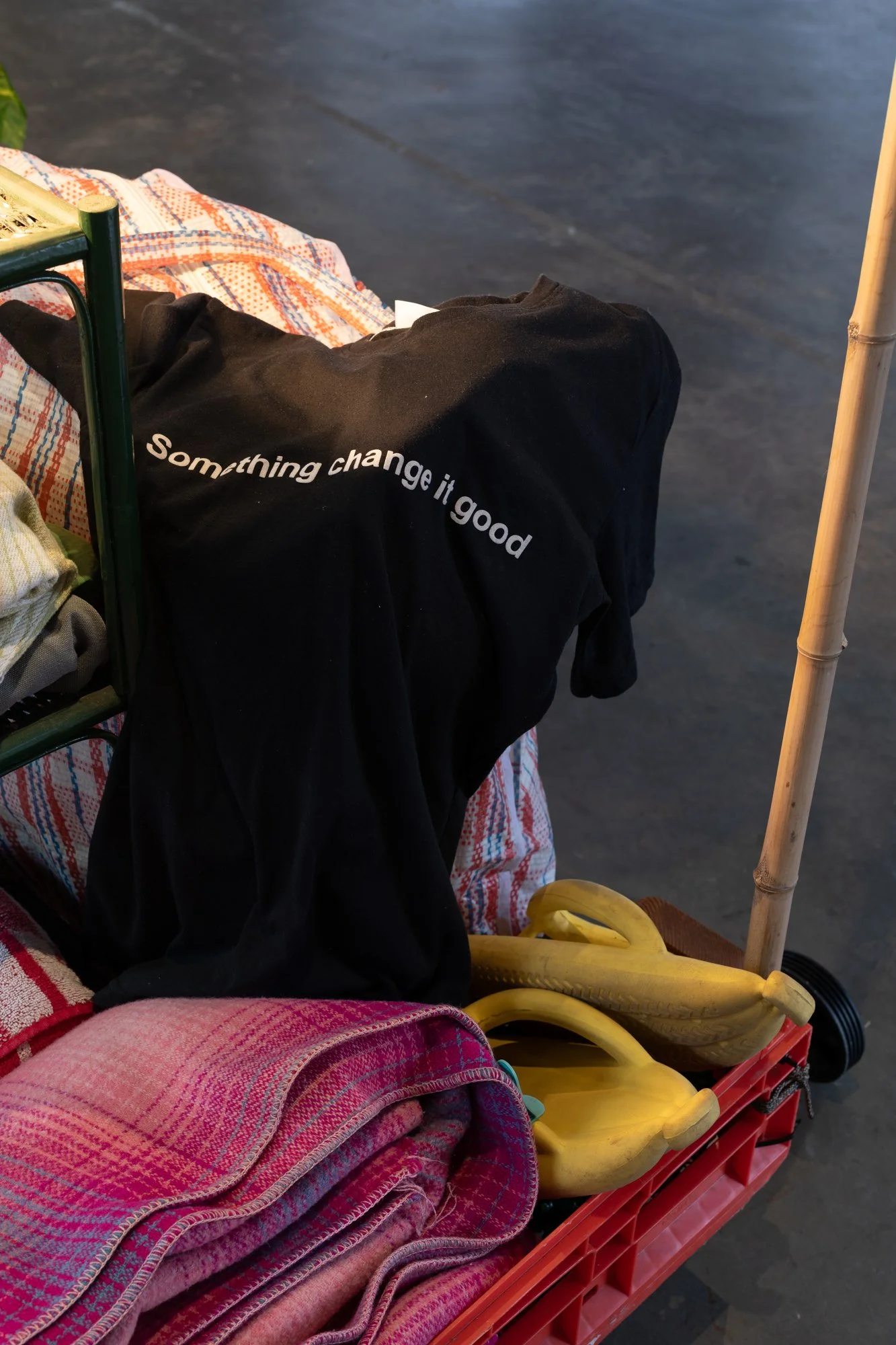
Madi Feist, The Snail (detail), 2026, INDI Rambler tricycle, found furniture and household objects, wood, metal hardware, bamboo, rachet straps, plants, pvc pipe, rope, assorted textiles, castor wheels, plastic, lamps, metal, shells, dimensions variable. Photography by Jessica Maurer.
[1] While the exhibition themes of How to dismantle the world are of a different theme, the inspiration for the exhibition title was Sufjan Stevens’ song title The Black Hawk War, or, How to Demolish an Entire Civilization and Still Feel Good About Yourself in the Morning....
[2] Oden, Robert Stanley. “A Comparison of the Political Thought of Huey P. Newton and Osama Bin Laden.” The Black Scholar, vol. 37, no. 2, 2007, pp. 53–60. JSTOR, http://www.jstor.org/stable/41069255. Accessed 19 Jan. 2026.
About the artists
Cybele Cox
Cybele holds a Master of Fine Art from the Sydney College of Art (Australia), and a Bachelor of Fine Art from University of New South Wales Art & Design (Australia). Her work has been part of curated exhibitions across Australia including: Nothing Human is Alien to Me, curated by Elyse Goldfinch, Ideas Platform, Artspace Sydney; Romance Died Romantically, curated by Amy Marjoram at Strange Neighbour, Melbourne; and the Australian Ceramics Triennale. In 2017, Cox presented Ornamental Hallucination 1, a significant solo exhibition at Firstdraft, Sydney (Australia). After completing a residency at The Vienna Academy of Fine Arts (Austria) in 2017, Cox exhibited in Vienna and was a recipient of the 2018 One Year Studio Artist Program at Artspace, Sydney. She participated in the group exhibition, The Stand Ups, curated by Elyse Goldfinch at Bus Projects, Melbourne (March 2022) and the 2022 edition of the Australian Ceramics Triennale (July 2022), And at The Australian Centre of Contemporary Art (ACCA), in From the Other Side, curated by Jessical Clark and Elyse Goldfinch. Cybele has recently presented her 2nd solo exhibition at Ames Yavuz Gallery (Sydney) and is held at The Art Gallery of NSW, as a finalist in the prestigious Wynne Prize, 2025. A series of new works were presented at the recent Sydney Contemporary Art Fair, Carriageworks, followed by inclusion in a group show called Puppets! Everyone Love Puppets, presented in Melbourne by Oigall Projects.
Madi Feist
Working primarily across sculpture and assemblage, Madi Feist is a multidisciplinary artist living and working on Gadigal land. Her practice centres on collecting discarded materials, peculiar objects or mundane remnants of daily life. She transforms this “junk” into works that playfully dissect how consumerism shapes the way she observes the world. Intuition and chance play a key role in guiding her process, as she almost exclusively uses objects she encounters on the street or within the rhythms of her everyday life, prompting reflection on where objects come from, where they end up, and why they matter. Drawing on her Italian and Filipino heritage, Feist constructs humorous and symbolic narratives expressed through her sculptures, with references that range from ancient mythology to personal anecdotes. Her works mimic familiar forms, yet on closer inspection reveal an uncanny materiality that encourages viewers to reconsider what is deemed valuable or disposable.
In 2025, Feist was awarded Gosford Regional Gallery’s Emerging Art Prize and was a finalist in Burwood Art Prize and Hazelhurst Art On Paper Award. In 2024, she presented her first solo exhibition at Puzzle Gallery and participated in group shows at China Heights Gallery and Passport Gallery. In 2022, she was a finalist in The Remagine Art Prize at Wallarobba Arts and Cultural Centre. In 2021, she completed a Master of Fine Art from the National Art School, Darlinghurst, where she majored in painting. During her studies, was the recipient of the East Sydney Doctors Scholarship (2020) and the Derivan Prize for Mixed Media (2019).
Barrie Goddard
Barrie Goddard is widely regarded as one of South Australia’s foremost landscape artists. He taught at the South Australian School of Art from 1963 to 1996 and was appointed Head of Painting in 1985. A significant contributor to the Hard Edge movement in Australia, his paintings are held in numerous public and private collections, including the National Gallery of Australia.
Across more than six decades, Goddard has established an extensive body of work exploring a range of themes and disciplines, underpinned by a sustained interest in our impact on the natural world and the interaction of colour and form.
He is based in Kaurna Country/Southern Adelaide and continues an active studio practice.
Isabella Hone-Saunders
Isabella Hone-Saunders is a curator, arts worker and artist, born on Kaurna Country/Adelaide, now living in Naarm/Melbourne. Their broader practice is concentrated on amplifying community and socially engaged practices and supporting artists in taking creative risks. The research projects Hone-Saunders has curated explore themes of habitat sharing, survival and extraction, to consider the interplay between human, animal, and ecological well-being. Currently they hold the role of Assistant Curator, Art Museums, the University of Melbourne. Formerly working as the Director of Seventh Gallery, Hone-Saunders has also held curatorial positions at the Australian Centre for the Moving Image (ACMI) and at the Australian Centre for Contemporary Art (ACCA). Hone-Saunders has a Master of Art Curatorship from the University of Melbourne and is a current PhD candidate in Curatorial Practice at Monash University. The core concept of Isabella's PhD research proposes hope as a generative and disciplined curatorial methodology and as a type of active recommitment that reorients despair and has the potential to cultivate new forms of solidarity.
Emma Pham
Emma Pham is an artist and arts worker based on Dharug and Dharawal lands in South-West Sydney. Her practice revolves around storytelling and narrative, often through game-inspired video work and digital animation. Using nostalgia as a whimsical point of departure, her practice wrestles with contested histories from a de-colonial and post-colonial perspective, and ideas of inherited histories.
Touching on stories within Western Sydney and beyond, Emma attempts to bridge the gap of cultural disconnection by leaning into play, self-invention and personal agency. Emma's storytelling involves the creation of kitschy and immersive pixel worlds, often rooted in personal/ family memories. The nostalgia evoked through pixel art aesthetics becomes mobilised in her work as a language and tool to explore the past, particularly in ways that resist status-quo narratives. Through this, she hopes to focus her practice on forging new pathways from the overlooked, in-between spaces of culture and history.
Nick Santoro
Nick Santoro is interested in the mundane and futile details of subcultures, trends and environments that he encounters. Through painting, he mashes together disparate references to people and places to create obscure scenes and exaggerated narratives. By recounting, celebrating and juxtaposing banal and prosaic images of everyday experience, he hopes to generate mysterious paintings where viewers can pick their own adventure.