
2018 Artistic Program
2018 Artistic Program
Andrew Bracey, Louise K. Wilson, Tim Etchells, Andrew Pepper, Cocker & Thornton, Rochelle Haley, Kate Corder, Steve Dutton, Luce Choules, Morrad + McArthur, Brazier & Free, Angela Bartram
Documents, Alternatives
18 January - 24 February

Documents, Alternatives #2, installation view, dimensions variable, 2018. Photography by Document Photography.
Artist Statement
The documentation of ephemeral artwork, works made to be transient, changeable and un-fixed, is often problematic for the intent and premise of creation as it aligns itself with a particular moment, place and viewpoint in time. Lens-based methods are mostly relied upon to communicate actuality and happening and to fix the un-fixed memory of the artwork, and this is part of that problem. Effectively, this type of documentary device works in opposition to the concept of the artwork, cementing into a fragmentary history when all it wants is to be fleeting in its temporarality. The lens-made recording tends to generalise vision and, by extension, it does not fully communicate the experience of ‘being there’ and present. Experience is difficult to replicate through a lens. This is problematic for artwork whose very premise is to be transient and time-based, and for which direct experience is a priority.
Karen Benton, Jessica Mei Cham, Harry Seeley, Justyna Stanczew
A studio based practice
Curated by Kim Nguyen and Bethan Cotterill
18 January - 24 February

A studio based practice, installation view, dimensions variable, 2018. Photography by Document Photography.
Artist Statement
A studio based practice unites works by four recent Sydney College of the Arts graduates who challenge art academy traditions through thoughtful subversions of studio-derived boundaries, expectations, and hierarchies. The traditional art academy model of studio based teaching divides students into studios based on their technical skills; students are then assessed based on ideologies and standards unique to their studio. A studio based practice positions the studio model as a fixture worth questioning by alluding to its roots and ongoing relationships with power, patriarchy, and class hierarchies through trans-disciplinary investigations of ideas and materials that are de-privileged by academy standards.
Nicole Barakat
We are infinite
1 March – 7 April

Nicole Barakat, We will return home, silk embroidered hand cut lamé on cotton velveteen, 2018. Photography by Document Photography.
Artist Statement
We are infinite is a collection of textile works responding to objects held in the Nicholson Museum from the artist’s ancestral homelands in the South West Asia and North Africa (SWANA) region. The artist presents the artworks as a series of visual manifestations of her process of listening and engaging in intuitive conversations with the museum objects.
Louisa Afoa, Natasha Matila-Smith, Molly Rangiwai-McHale
Heavenly Creatures
1 March – 7 April

Heavenly Creatures, Louisa Afoa, Natasha Matila-Smith and Molly Rangiwai-McHale, installation view, dimensions variable, 2018. Photography by Document Photography.
Curatorial Statement
In the exhibition Heavenly Creatures, artists Louisa Afoa, Natasha Matila-Smith and Molly Rangiwai-McHale find their agency in the personal and intimate. The artists, each from Aotearoa/New Zealand, don’t claim to speak for everyone, but represent three perspectives amongst the many diverse voices of Indigenous and First Nations people. Their works demonstrate that Indigenous voices are complex and unpredictable in their positions.
Marikit Santiago
Coca-Colonized
1 March - 7 April
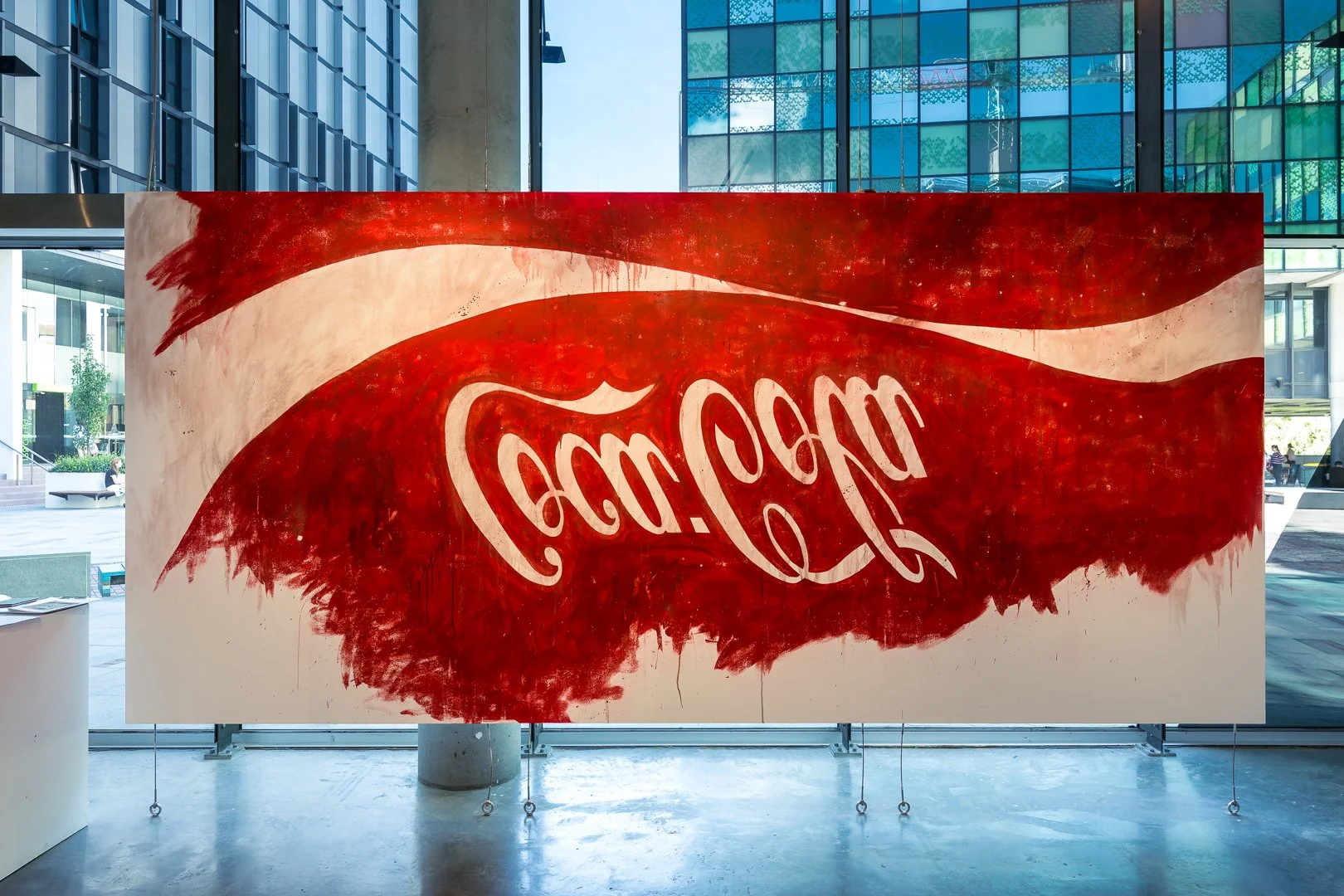
Marikit Santiago, Coca-Colanisation, installation view, 2018. Photography by Document Photography.
Artist Statement
“Coca-Colanization” is the term used to describe the globalisation of American culture through popular American products such as Coca-Cola. In the context of this exhibition, the term is an access point for discussions around colonial occupation in the Philippines and subsequent attitudes conditioned by a Western presence in a developing world. The show aims to illustrate the competing and complex tension between my dual cultural identities as an Australian with Filipina ethnicity, but also demonstrate the established pattern of colonial benevolence between Australia and the Philippines.
Jodie Whalen
Don’t think of me as gone
12 April – 19 May

Jodie Whalen, Don’t think of me as gone, installation view, Verge Gallery, 2018. Photography by Document Photography.
Artist Statement
Don’t think of me as gone is a new installation that asks the viewer to question ideas of love and devotion, grief, obsessions and belief, beauty and fantasy. Employing experiences, routines and rituals of the everyday. Repeated experiences that are designed to take us from one state into another and that marks the progression of time.
This new body of multisensory work is the artist’s response to ideas surrounding the limitations, frustrations and despair inherent in the pursuit of fantasy and beauty. The response will be elicited in relation to the emotions of love and grief.
Using video, assemblages, collage/photomontage, and scent, Whalen’s practice of site-specific installation envelops the audience through its relational harmony/balance to image, material and site. Pushing the audience to respond to the site as a place of reflection, meditation and ritual.
Kieran Bryant
grappling on the precipice of the squirt and the stream
12 April – 19 May

Fluid feelings, Neil Beedie performance, 2018.
Artist Statement
grappling on the precipice of the squirt and the stream presents a series of video, mixed-media installation, and collaborative performance that examine differing modes of a fluid queered body experience in its connection to both water and the hole. Looking at the connections that can be made between man-made watery sites such as dams, fountains, canals and sewer drains, and the human body; particularly sites of control, shame, and regret in a queered body. This exhibition asks how water, through its relationship with holes and orifices, can be a conduit to discuss themes of queer visibility and identity signification; re-contextualisation of image and sound in popular and contemporary culture; and collaborative distance. An exhibition text written with Spence Messih addresses some of these themes in a collaborative back and forth that touches on the use of sensuality. This new work was developed at the Cité Internationale des Arts Paris with the support of UNSW Art & Design and the generosity of Mr Ross Steele AM.
Christine Ko
Model Home
24 May – 30 June

Christine Ko, Model Home, motorised vertical blinds with mirror tint film and frosted film, dimensions variable, 2018. Photography by Document Photography.
Artist Statement
Christine Ko works with large scale installation and photomedia to explore marginality and spaces characterised by the ‘in-between’. Ko’s practice uses an autoethnographic methodology to explore the liminal experience of the modern Chinese-Australian immigrant and conflicting multi-cultural identities. By interrogating spaces of liminality and hybridity, Ko explores feelings of ambivalence—between hopes, dreams, invisibility and guilt, which can result from experiencing cultural displacement as an immigrant, to create installations that often use immersion to engage with the audience.
Elena Papanikolakis
Parting Words
24 May – 30 June

Elena Papanikolakis, Parting Words, installation view. 2018. Photography by Document Photography.
Artist Statement
Parting Words presents new works comprising collage, text and painting.
The works in the exhibition explore the realm of departures, from the finality of death, to deviations from context, form and function. It considers departures in terms of distance or removal from people, places, ideas and culture; to aberrations, and diversions between message and meaning.
Danica Knezevic, Pamela Pirovic, Tayla Jay, Georgia Boe, David Collins, Blake Lawrence, Yiorgo Yiannopoulos
Critical Bodies
Curated by Julie Rrap and Cherine Fahd
5 July – 11 August

Danica Knezevic, It’s Hard To Keep Your Head Above The Coffee Table, endurance performance documentation, 2014, installation 2018. Photography by Document Photography.
Artist Statement
Critical Bodies is an exhibition co-curated by artists Julie Rrap and Cherine Fahd. It presents the practices of seven early career artists: Georgia Boe, David C. Collins, Tayla Jay, Danica Knezevic, Blake Lawrence, Pamela Pirovic, and Yiorgo Yiannopoulos. The exhibition focuses on contemporary photographic and video work along with performance and objects that place the body at the centre of investigation.
Jessica Herrington & Anna Madeleine
Emotions Invented by the Internet
16 August –22 September

Jessica Herrington, Hidden Spaces, augmented reality app, 2018. Photography by Zan Wimberley.
Artist Statement
Emotions Invented by the Internet by Jessica Herrington and Anna Madeleine is an exhibition of augmented reality (AR) and virtual reality (VR) artworks exploring emotional states instigated by new technologies. The feeling of helplessly watching a slow download; the feeling of trying to make two devices find each other through Bluetooth; or the feeling of finding that perfect GIF – these emotions range from the tranquil to exhilarating, funny to frustrating. Through 360 degree animations and dream-like digital relics, this exhibition presents a simulation and a remedy for future mental states, in a meditative response to living with new technology.
Tully Arnot, Josh Harle, Jason Phu, Brenton Alexander Smith, Jason Wing, Louise Zhang
Human jerky: meatbags through the eyes of technology
16 August – 22 September

Tully Arnot, Lonely Sculpture, cast silicone, Arduino nano, servo motor, electronics, phone, Tinder app, Tinder profiles, 20 x 5 x 5cm (approx.), 2014. Photography by Zan Wimberley.
Artist Statement
Emerging technologies such as robotics move beyond abstract interaction and into direct engagement with the physical world. With them comes an explosion of domain-specific models to understand and negotiate the human body. From surgical robot models, crash test dummies, and sex robots, to automated battlefield drones and the ethics algorithms of self-driving cars, these technologies are fundamentally carnal – tasked with managing the needs, desires, values, threats, and vulnerabilities of human flesh. Their internal aesthetics are alien, frightening, and monstrous.
Fiona Davies, Merryn Hull, Nerine Martini, Bernadette Smith, Eila Vinwynn
In Translation
18 October – 3 November
Presented by University of Sydney Master of Art Curating students: Faye Chen, Karen Cheng, Amber Fu, Rachael Helmore, Tian Kang, Yunyan Tang, and Danyi Wang
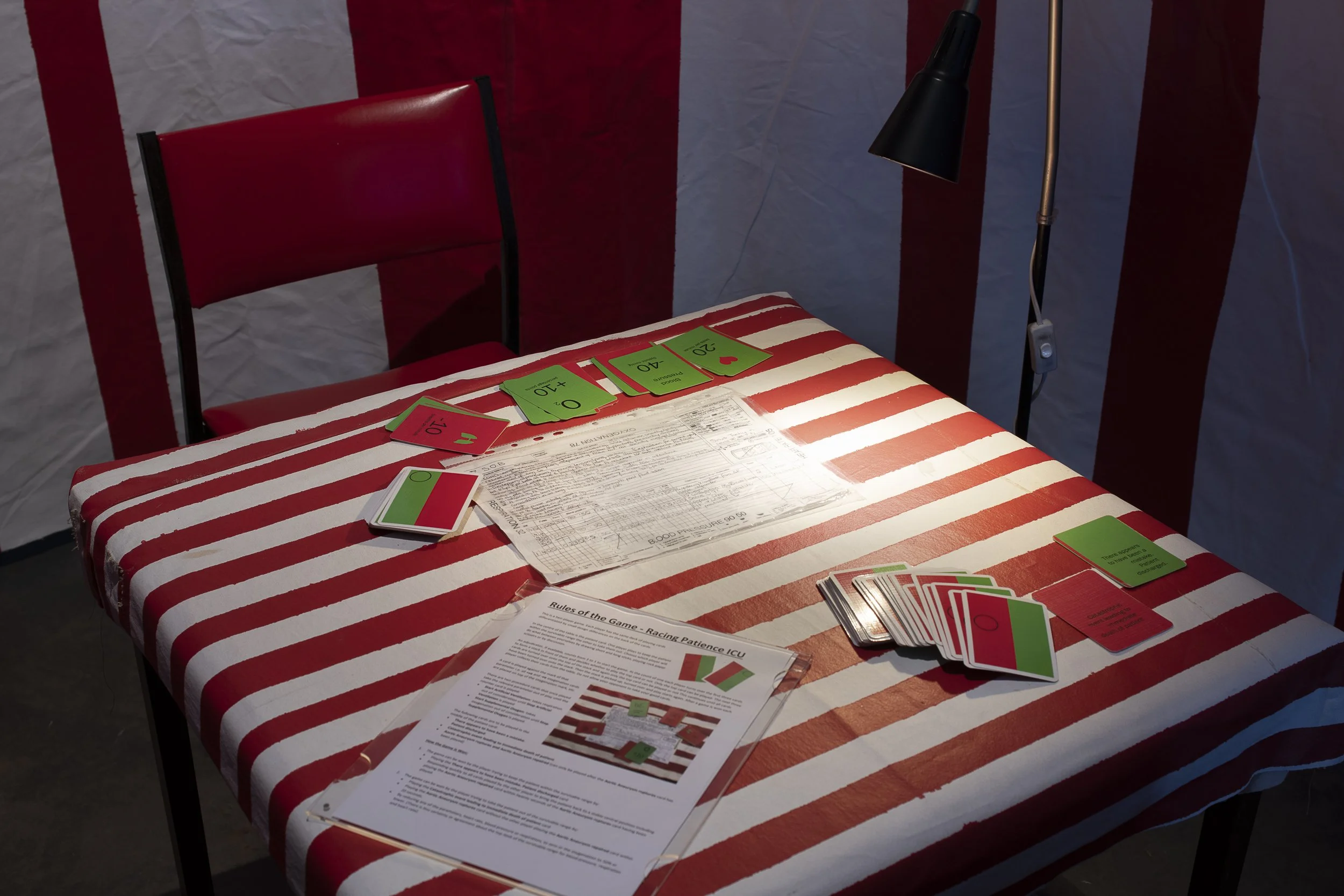
Fiona Davies, Racing Patience ICU, canvas, paint, found objects, two packs of cards, printer material, 270 × 290 × 1.7 cm, 2018. Photography by Zan Wimberley.
Curatorial Statement
To translate is to convert something from one form into another; aiding communication and meaning across languages, times, cultures, or mediums. In Translation brings together the work of five postgraduate artists from Sydney College of the Arts: Fiona Davies, Merryn Hull, Nerine Martini, Bernadette Smith, and Eila Vinwynn. As each artist translates their ideas across different mediums, meanings are continually challenged and restructured. Their investigations range from the refraction of light to material transformations, from structures of language to the intersection between life and death.
Curated by students currently studying the Master of Art Curating at the University of Sydney, In Translation coincides with three further exhibitions at Sydney College of the Arts, which feature each artist in more depth. With this collaboration across campuses comes the movement and ‘translation’ of artworks and ideas from one space to another, and the consideration of each artist, curator and viewer as both ‘translator’ and meaning-maker.
110%, Amber Boardman, JD Reforma, Kate MItchell, Min Wong, Sara Morawetz & Will French
Personal Best
Curated by Tesha Malott, Rebekah Raymond and Helen Waller
8 November – 15 December

Sara Morawetz, ALL MY FAILURES, [part of series All My... (2017-ongoing)], Runway Australian Experimental Art Magazine commission, Artist Book, 2017. Photography by Zan Wimberley.
Artist Statement
Originally, a personal best was a sporting term, describing the greatest achievement one had ever had. Now it could be argued that achieving one’s personal best is an underlying motivation for every action we take. This exhibition asks the question—what is it about the human condition that makes us push ourselves to be faster, higher and stronger and how does ‘wellness’ fit into this dialogue? While the pressure to be successful in the era of Capitalism isn’t new, the exhibition looks at how we view achievement today, when now more than ever the the cult of the winner is revered.
Personal Best has been curated by the Verge team and features artists 110%, Amber Boardman, JD Reforma, Kate Mitchell, Min Wong, Sara Morawetz and Will French who will present works illustrating different perspectives on success, failure and the absurdity of seeking impossible perfection.