
Screwball

Athena Thebus & Chloe Corktan, ‘In Dramatic Roles Such as These’, 2022. Image courtesy of the artist.
Curatorial Statement
Did you expect a happy ending?
- Bugs Bunny
The Screwball is a slippery figure. Itis made up of multiple referents, always pointing elsewhere. On the one hand, it points to a classical Hollywood comedy style that engages gender and sexual tensions, often across class lines. It also points to screwy personas like the clown, the jester and the fool. Screwing or fooling around means to toy with, to test, to tease. This exhibition harnesses the playfully referential nature of the screwball to frame performance and video practices that exist on the edges of citation. These slightly off depictions of reality challenge what is usually considered intact and valuable.
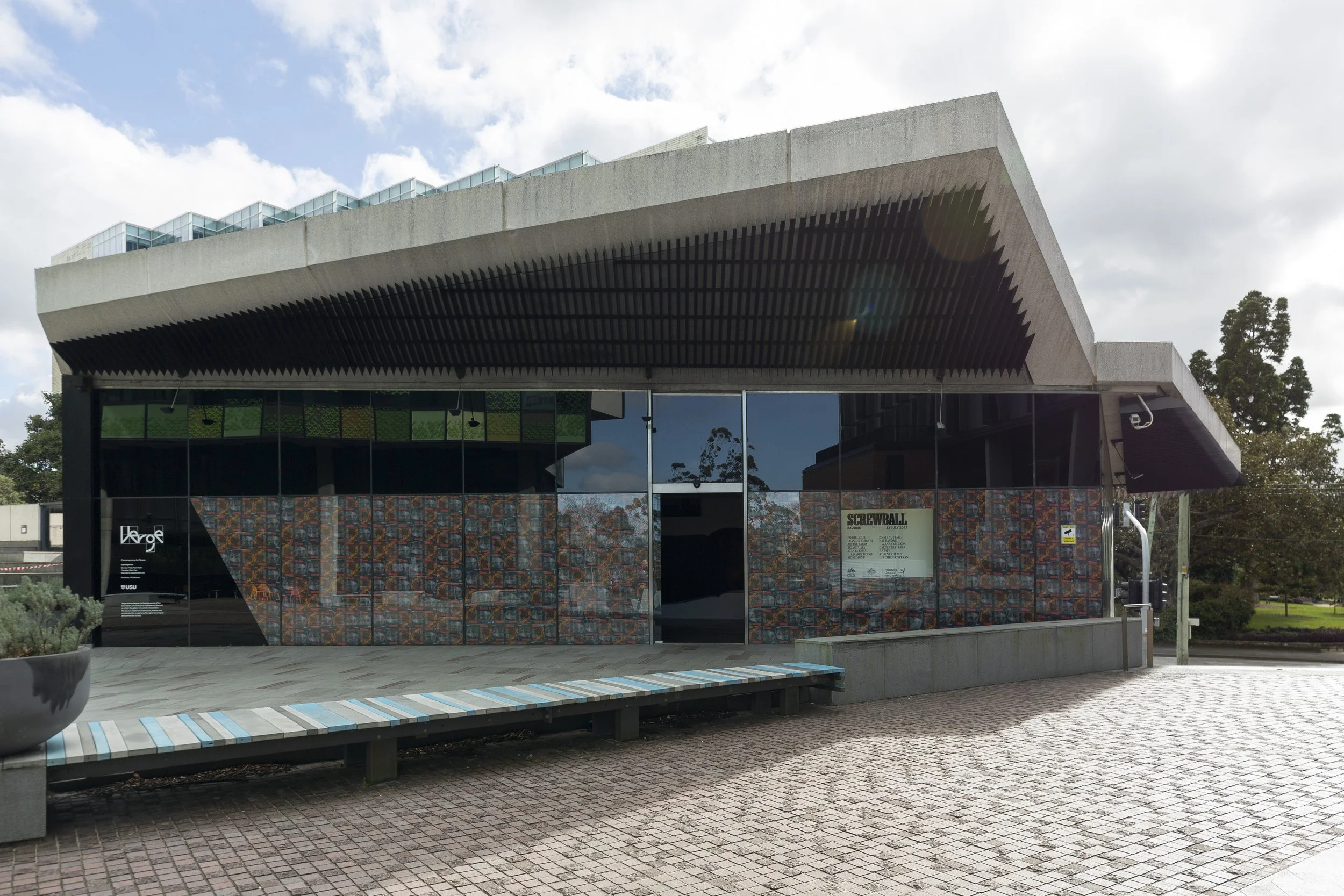
Screwball, 2022, installation view of magazine covers covering Verge windows, dimensions variable. Photography by Jessica Maurer.

Chloe Corkran & Athena Thebus, In Dramatic Roles Such as These, 2022, wallpaper, 61 cm x 1.6 cm. Photography by Jessica Maurer.
Just wait till I get my hands on that scwewy wabbit!
Elma J. Fudd
She has a nosebleed. Hard to say why. Has she been punched? The blood trails down her cheek, over her mouth, to her jawline. She is standing in the California desert. To her right side is a highway, to her left, a cliff over a gushing dam.
An ambulance goes by, its sirens trilling.

Frances Barrett, The Verses of Doctor Mother (detail), 2022, flouro pink cloth tape, A2 paper, dimensions variable. Photography by Jessica Maurer.
She stares into the camera, a perplexed expression anchored in her brow. She talks, almost compulsively, to the camera operator, scrambling to hold their attention.
She is wearing a green dress with white polka dots, cut off above the knee. Over this she has on a brown suede vest, laced up at the front. On her head she wears a viking helmet with two sewn-in, fake blonde braids. She is holding a large piece of swiss cheese made from rubber.

Harry Dodge & Stanya Kahn, Can’t Swallow It, Can’t Spit It Out, 2006, single-channel video, 26 minutes 10 seconds. Photography by Jessica Maurer.
The effect is citational – recalling Elmer J. Fudd’s costume in the classic Warner Bros’ cartoon What’s Opera, Doc? (1957).
For California-based artist collaborators Harry Dodge and Stanya Kahn, re-embodying the originally animated figure of Elmer J. Fudd supports a broader methodology in which the alienation and violence of contemporary life is approached through the absurd.
Dodge and Kahn are not the only artists to make use of this pop-cultural reference point. Australia-based collaborators’ Athena Thebus and Chloe Corkan also engage the bunny motif in their large-scale, hand-studded, leather-hide work Bunny (2021), which recalls Bugs Bunny as a “horny innocent” whose fluffy cuteness slyly diverts the “wrath of her enemies with the bat of an impossibly long eyelash while animatedly fucking the world.”

P. Staff, Pure Means, 2022, single-channel video, 4 minutes 47 seconds. Photography by Jessica Maurer.
In Patrick Nation’s experimental documentary Give Up On Hopes and Dreams (2021), Terre Thaemlitz also takes inspiration from Bugs Bunny and Elmer J. Fudd. Proposing a transanalysis of What’s Opera, Doc?, Thaemlitz reads Bugs Bunny as a transfeminine figure who utilises drag and passability as a means to escape the cis-male hunter’s wrath. Bugs Bunny might also be read as phalloobsessed or, perhaps more accurately, castration-obsessed, chomping through carrot after carrot with the kind of cool disregard that Freud might diagnose as over-compensation.

Anna Breckon & Nat Randall, Piece of Work (detail), 2022, three-channel video, loop. Photography by Jessica Maurer.

Anna Breckon & Nat Randall, Piece of Work (detail), 2022, three-channel video, loop. Photography by Jessica Maurer.
Although Thaemlitz takes Elmer J. Fudd as representative of the cis-male, he could also be understood as an important transmasculine icon. Classic pointers would be his small stature, the phallocentricity of his costuming, specifically his gun, his failed machismo and his service-bottom tendencies, which blossom forth in the face of attraction, a sexual tendency that surfaces at the very beginning of Elmer’s Looney
Tunes career.
The first Bugs Bunny and Elmer J. Fudd cartoon, A Wild Hare (1940), has a strong gloryhole motif. It commences with a soon to- be-familiar white-gloved hand emerging from a rabbit hole to grasp the carrot left as bait by Elmer. When the gloved hand retracts into the hole, Elmer inserts the barrel of his gun after it. As Elmer thrusts the gun deeper into the hole, Bugs takes hold of it and pulls it even deeper, yanking it in and out repeatedly. Bugs finally pulls Elmer’s head into the hole and plants a kiss on Elmer’s lips.

Sione Monū, Only Yesterday, 2020, single-channel video, 8 minutes 9 seconds. Photography by Jessica Maurer.
A Wild Hare is the only episode that shows Bugs and Elmer kissing. It ends with Elmer crying which prompts Bugs to turn to the camera and say, “You know, I think the poor guy is screwy.” It is Bugs and Elmer’s shared screwyness that speaks to gender ambiguity, homoeroticism, trans-eroticism and an undoing of the heteronormative frameworks on which the Looney Tunes’ comedy also relies.
Screwball operates in two ways. On the one hand, “screwy” can attach to a character or behaviour that is odd or off and so something to be laughed at; on the other, it is more of a navigational tool or methodology, a screwballing of convention that engages the obscene. In either case, the screwball operates within “real” or “everyday” environments, including sites of suburbia and domesticity, in order to challenge what is considered intact and valuable.

Garden Reflexxx, Blue Car, 2022, single-channel video, 10 minutes 57 seconds. Photography by Jessica Maurer.
The screwball figure is like a clown insofar as their humour is very physical but also carries sadness; there is a melancholy buried away in their serious commitment to the task at hand. The screwball is also like a court jester in their ability to bend perspective, twist meaning and speak truth to those in power. But the screwball differs from these archetypal figures in taking gender and sexual tension as their primary area of play.
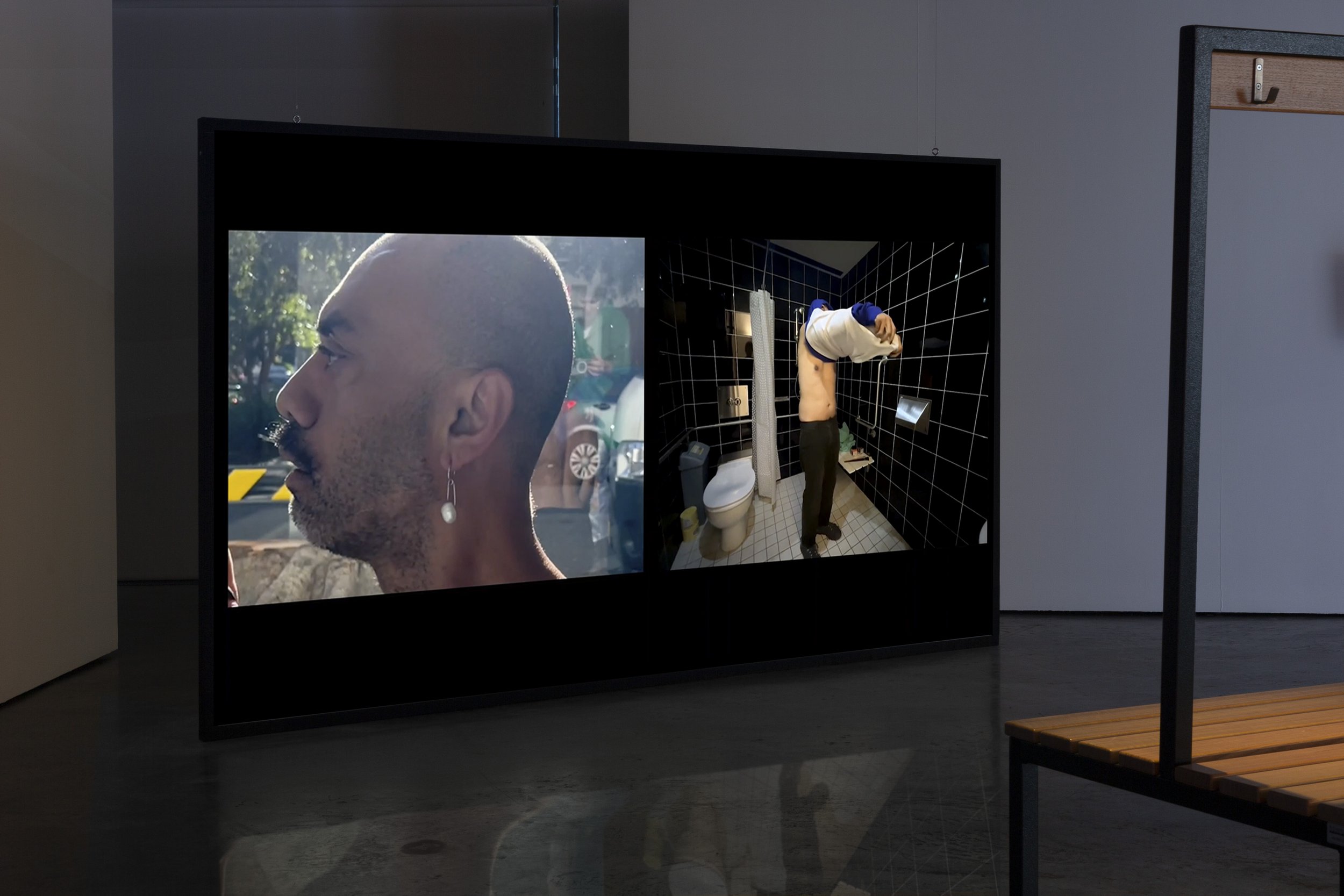
Brian Fuata, 2022, Negativity, single-channel video, 10 minutes. Photography by Jessica Maurer.
The screwball figure always engages the body in debauched pursuit of the imagination. The screwball is elusive and perverse; they swivel and side-step. Like everyone else who finds their métier on film, they desire to be looked at but deflect the gaze if and when it does not suit them.

Archie Barry, Scaffolding (Preface), 2021, single-channel video, 11 minutes 20 seconds. Photography by Jessica Maurer.
Taken as a verb, screwballing is a way of toying with the filmic conventions that guide us in how and where we look. “Screwballing” means to make the camera an explicit element of the plot. It draws our attention to visual mechanics while paradoxically immersing the viewer in the “authenticity” of the depicted action. This screwy way of making work isn’t about planning illusionary worlds: it is about the action of living. A way of passing time, the screwball engages relational, non-normative forms of sensuality, pleasure and connection. Unlike narratively driven forms, the screwball understands duration in relation to a kind of fetish-time, an experience of time as seen rather than measured.

(left) Jimmy Nuttall, 'Fabulina', 2019, single-channel video, 19 minutes 55 seconds. Photography by Jessica Maurer.
(right) Chloe Corkran & Athena Thebus, In Dramatic Roles Such as These (detail), 2022, wallpaper, 61 cm x 1.6 cm. Photography by Jessica Maurer.
The screwball amounts to a sensual and intimate mode of image-making that takes pleasure from uncertainty and interminability. The works curated in this exhibition utilise screwball methodologies in order to keep us in a promiscuous state of movement. They collapse the distinction between truth and fiction, character and persona, scripted action and improvisation. The screwball cites rather than depicts reality. It uses humour, play and trickery to make sense of difficult matters in accessible modes. Instead of interrogating individuality or putting it on the spot, it offers a strategy for the proliferation of selves in the name of what might be.
EO Gill
Biography
EO Gill is a video artist living and working on Gadigal land (Sydney, Australia). Their creative practice research speaks to bodily sites of tension, suspension and play explored through a self-reflexive documentary style. Gill was the recipient of the Create NSW Visual Arts (Emerging) Fellowship (2018) and has exhibited at Bundoora Homestead (Vic) and Artspace (NSW) among others. They are currently undertaking a PhD at the University of Sydney.
