
This Is Who I Am
Soo Min-Shim, Athena Thebus + Chloe Corkran, Zoe Wong, EJ Son, Lilly Lai
This Is Who I Am
Curated by Sharon Hong
16 January – 7 February, 2020

Athena Thebus + Chloe Corkran, Drippy Rock, vinyl, 2019. Photography Zan Wimberley.
Curatorial Statement
“This is who I am” explores the experience of being queer Asian-Australian; the familial connections, cultural expectations, and the binary conflicts on the disparities of the East and West. The exhibition showcases five contemporary, emerging artists who identify as Asian-Australian and Queer on the Asian diaspora—within the intersectionality of our socio-political and socio-cultural climate.

Zoe Wong, Little Brother, 2019. Photography Zan Wimberley.
Zoe Wong’s photographic series, The little brother (2019) features two different versions of anecdotal text and images recounted by her dad about the disappearance of his little brother in Macau. The left side is a recount of how the artist initially remembers the story followed by two photographs of a fictitious desk, slightly different from one another. The right side is a recent retelling of the story. The discrepancy of the narrative between the two is reflected by the subtle changes in composition and text.

Zoe Wong, I Can’t Speak Chinese, 2020, installation view. Photography Zan Wimberley.
I Can’t Speak Chinese (2020) is a series that plays on the format of traditional Chinese calligraphy. Zoe Wong’s scroll paintings express the inner angst and thoughts resulting from an upbringing straddled across her bicultural identity (Chinese/Australian). Through using an oriental style font, the English text conveys a somewhat melancholy/comedic reflection on Asian stereotypes and musing of personal racial experiences. The two series complement each other as a discussion into the disparity of the East and West language.

Athena Thebus + Chloe Corkran, Drippy Rock, vinyl, 2019. Photography Zan Wimberley.
The work Drippy Rock (2019) is a collaborative piece between artist’s Athena Thebus and Chloe Corkran. This work reimagines the artists early manifestations of desire, inspired by the luscious images of feminine pop icons that catalysed their parallel longings. Thebus and Corkran characterises themselves as elves, an identity that goes against the binary nature of human experience, we see them as supernatural, beyond the understanding of possibilities. The closeness of the two, enveloped by the surrealistic environment of the forest, captured in shared otherworldly moment as if time ceased is in itself a queer image of desire.

EJ Son, 아딸, single channel video, various sculptures and drawing, 7:01 min, 2019. Photography Zan Wimberley.
EJ Son’s work, 아딸 (2019) is a translation created through a hybrid of the two binary Korean words of son and daughter. The tattoo is symbolic, cementing EJ Son as a fluid entity, unconcerned by the inherent structure of gender roles. The combination of son and daughter, written in Korean, was invented by their mother during the complex discussion around gender, reflecting the ever-present conflict with family on gender identity and its cultural implications. The social expectation and innate separation of masculine and feminine roles is addressed by marking themselves with the word ‘아딸’ as a transformative journey into personal growth.
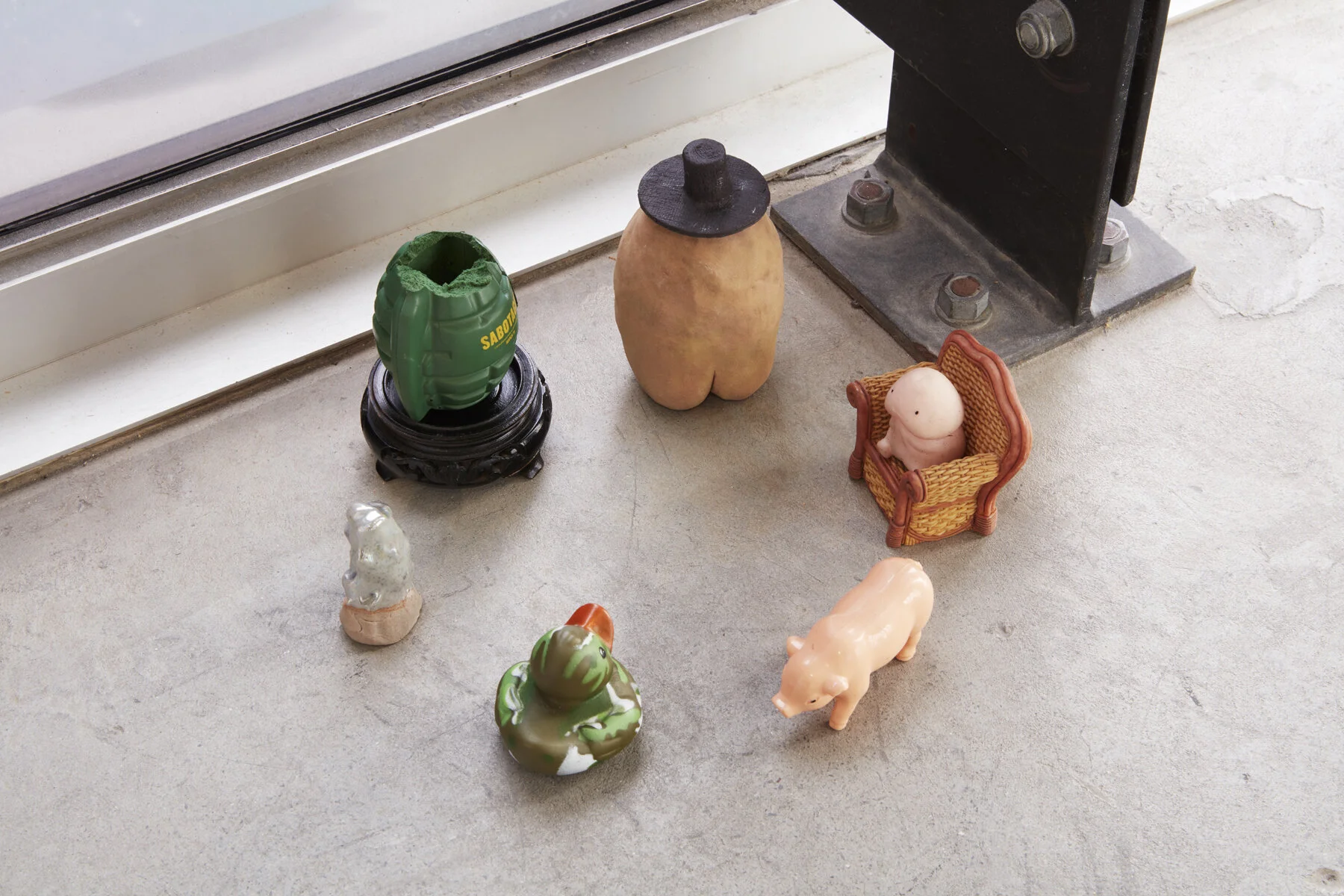
EJ Son, 아딸, installation view, 2019. Photography Zan Wimberley.

EJ Son, Untitled, glazed stone ware, varied dimensions, 2019. Photography Zan Wimberley.

EJ Son, Untitled, glazed stone ware, varied dimensions, 2019. Photography Zan Wimberley.
In Lilly Lai’s video piece, Fatty 69 Executive Chic the Movie (2020), is focused on the act of forging familial connections. The disconnect is reflected through reasons of distance, culture expectations and passing, utilising imagery and sound, deeply rooted to memories of family members the video is accompanied by a 'soundtrack' of Teresa Teng's, My Heart Represents the Moon. Through this collaboration the artist aims to reconnect with immediate family and a meditated act of unrequited love towards the extended family, the ancestors before us and the generations after. As a POC artist they aim to question the reason behind making queer art as more than a spectacle or performative gesture within the structures of the gallery space, hoping to bring a more personal touch. The work is the beginning of growth in Lai’s practice as they hope to expand the notion of familial connection in future practices.

Lilly Lai, Fatty 69 Executive Chic the Show 1&2, 65” inch screen with tv crib and sound, 6:49 min, 2020. Photography Zan Wimberley.

Lilly Lai, Fatty 69 Executive Chic the Franchise, A4 printed postcards, 2020. Photography Zan Wimberley.
Red Thread (2019) questions the distinction between invisibility and erasure in a bi-cultural context, being Korean and Australian. Soo-Min Shim felt an overwhelming sense of loss of identity and becoming unseen, navigating a world in need of validation from mainstream paradigms. Her Korean heritage and lineage (blood relations) deriving from Korean Confucianism, emphasizes the duty of respect, obedience, and care for one's parents. Her queer identity directly challenges these teachings resulting in the feeling of being unseen. Her words aim to unravel and unlearn what has been embedded and taught, undoing the hurt imposed by cultural expectations by searching for reasons to exist.

Soo-Min Shim, Red Thread, A4 vellum, 29.7cm x 42 cm (framed), 2019. Photography Zan Wimberley.