
2016 Artistic Program
2016 Artistic Program
Hamish & Rose
Adrian Clement and Hayley Rose Hill
White
14 January - 30 January
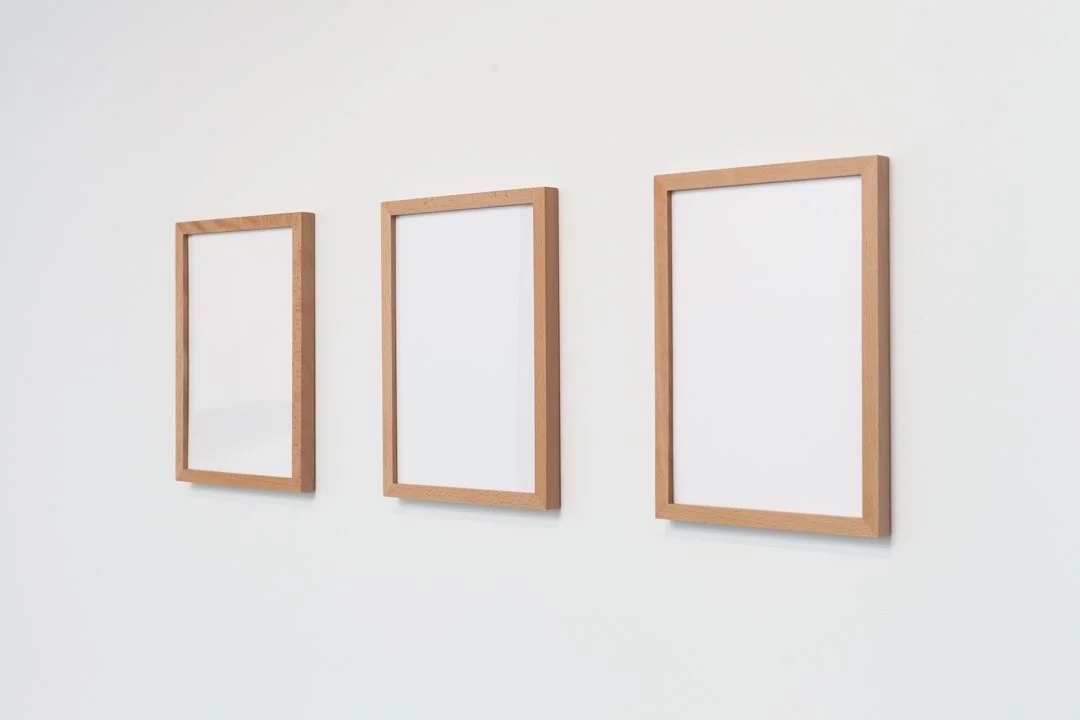
Almost, 2016, Inkjet prints on archival cotton rag paper, 29.7 x 21 cm. Edition of three plus two artist proofs. Photography by Document Photography.
ID: There is three light brown wooden frames hung spaced across a white wall. In each frame there is a white piece of paper.
Artist Statement
White is a project by Hamish & Rose, a collaboration between Adrian Clement and Hayley Rose Hill. The exhibition is influenced by graphic designer Kenya Hara’s 2010 publication White. Exploring white, not as a colour, but as a sensory experience that is linked, in traditional Japanese culture, to emptiness and silence. The concept is liminality is central to many of the works which comprise the exhibition, bringing the viewer to the threshold between the perceptible and the imperceptible. From near-invisible translucence to overwhelming opacity, the boundaries of white are challenged and become impossible to define in intellectual or dualistic terms. Through the mediums of photography, printmaking, sculpture and installation, the artists seek to express and present both the materiality and the sensory experiences of white itself.
Alma Studholme
Accreation II: Ontological Transmutations
14 January - 30 January

Untitled, 2016, installation view, terracotta surfaced with terra sigilata, salt. Photography by Document Photography.
ID: There is a terracotta spherical ceramic ball with a hole on the top, sitting on a pile of white salt in a concrete gallery space, with a backdrop of a white wall.
Artist Statement
Alma Studholme's solo exhibition Accreation II: Ontological Transmutations is designed around the broken pieces of the "Firing Enso" porcelain sculpture featured in the Verge Gallery's 2015 group exhibition Accreation: Un-becoming and the Surface as Sight. The broken sculpture takes a central position in the Mandala Project which includes the Salt Mandala Installation and two videos; one being a collaboration with Youngdong Kim and the other Studholme's performance of making the salt mandala. Kim's recording of Studholme's brainwaves during meditation shows them transformed into Buddhist mandala patterns that are "broken" at certain intervals by distractions. The distractions are indicated in the video by the emerging colour.
Throughout the exhibition the ontological states of being fragmented and being whole are explored in visual links between a circle and a single point of focus.
Monika Behrens
The Hunting Trophy
4 February - 27 February

Unbreakable, 2013, Inkjet prints on archival cotton rag paper, 29.7 x 21 cm. Edition of three plus two artist proofs. Photography by Document Photography.
ID: This is an image on a black background, with six long-stem wine glasses of varying shapes and sizes positioned upside down so that the rim of the cup is facing down. The surface the glasses are on are depicted to be highly reflective, almost like a mirror. Inside the glasses are toy soldier figures in colours of khaki, green and grey. They are positioned holding guns, standing and crouching.
Artist Statement
Within this work, Monika Behrens closely researched 17th century Dutch Still life painting. Behrens proposes that each sub-genre of the tradition contains a modality exclusive to their style – beyond the narrative and semiotic readings and beyond the general aesthetic values that are conventionally ascribed to the painting genre. Her exhibition at Verge focuses on the subgenre of Hunting Trophies. Behrens has found that the relationships between objects in Hunting Trophies involve an orgy of texture friction. To reconstruct the subgenre Behrens employed materials that comprehend its modality, in this case; tangled synthetic fur, sea creatures, jelly cups, golden guns and bananas are used to comprise the texture friction. The final paintings appear more as constructed painted monsters than still life paintings.
Paraskevy Begetis, Ciaran Begley, Simone Darcy, Clare Hooper, Nicole Easterbrook, Akira LAskerm Nathan Lasker, Tom Malek & Yirgo Yiannopoulos
Traces
Curated by Nina Dodd, Helen Waller & The Verge Gallery Volunteer Committee
4 February - 27 February
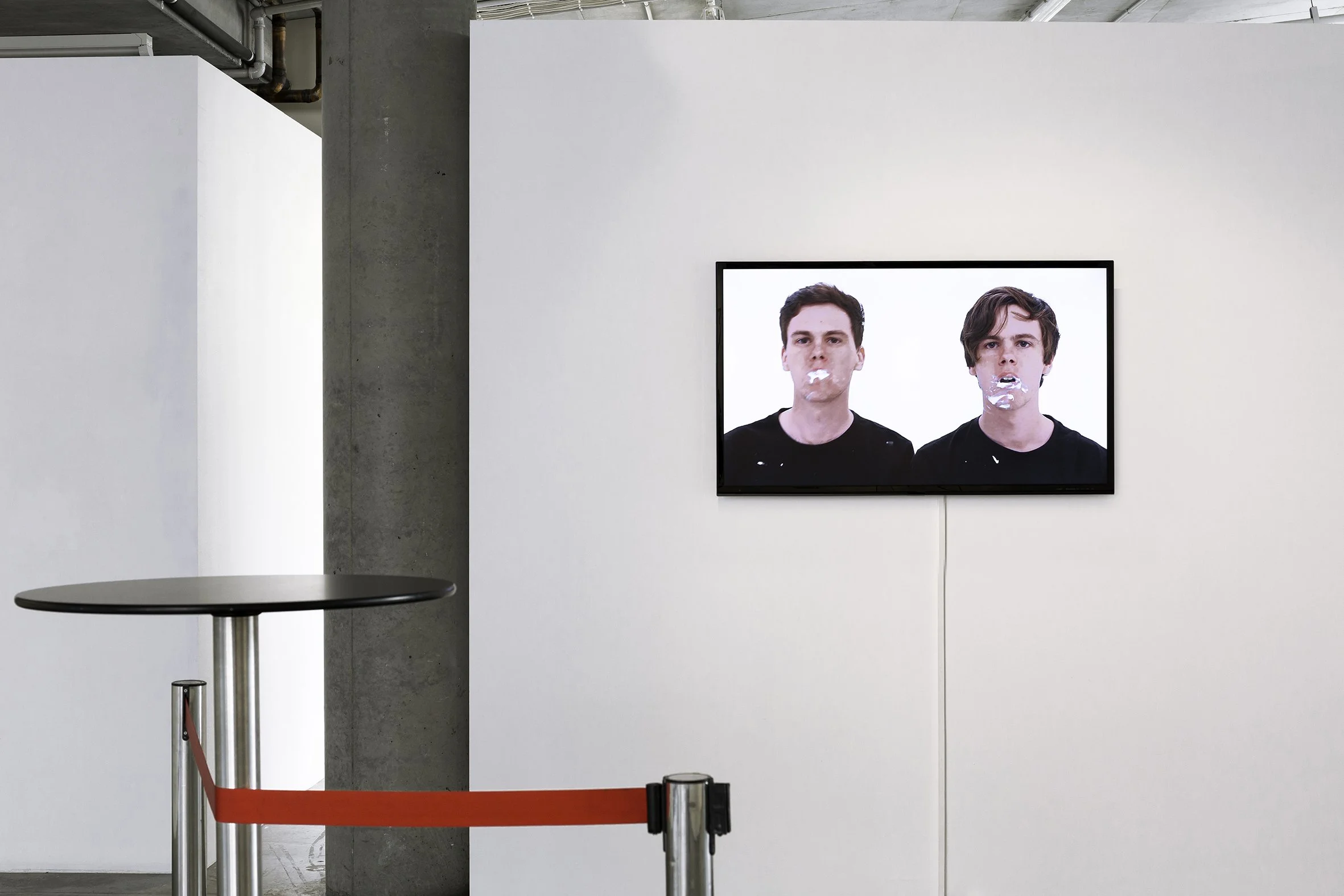
Akira and Nathan Lasker, Oedipals, 2015, installation view, 4 minute HD video performance. Photography by Document Photography.
ID: This is a black circular cocktail table to the left of the image, with a red barricade strap around one side of it. To the centre-right of the image, there is a television screen with two men on the screen. One has slightly shorter brown-orange hair than the other, but both are wearing black t-shirts with cream smeared across their face.
Curatorial Statement
Traces examines the various relationships to artistic practice, as documentation or residue of an performance or action, the image or object reimaged through appropriation, the familiar made uncanny and the blurring of the definition between image and object.
A trace can be understood as, “a mark, object, or other indication of the existence or passing by of something”. This expansion of this definition as a curatorial concept looks at the temporality of objects and experiences. These things, whether objects and/or experiences, become remains that are remembered and reimagined. Approaching the concept of traces from disparate artistic practices, the works document, appropriate, and re-construct materials. Thus lending new life to images, objects, spaces and stories. This exhibition highlights the relationship between image and object, and investigates the role of memory in investigating and reinventing histories and identities.
Bonita Bub, Consuelo Cavaniglia, Aideen Doran, Deb Mansfield & Lena Nyadbi with collection works by George Duncan, John Drummond Moore, David Stephenson & the Macleay Museum
Coppice
Curated by Katrina Liberiou and Siân McIntyre
3 March - 2 April

Coppice, 2016, installation view. Photography by Document Photography.
ID: In the gallery, there are three white walls and a white plinth with a glass lid in the middle. On the first wall to the left, there are five hand drawn layout plans on white and cream coloured paper, drawn in black and red pen and marker. On the wall in the far back, there are two black and white prints framed in black lined frames, hung next to each other. On the right wall, there is a distorted light wooden frame with a photograph of bark and trees in it, with a reflection of the back wall within the middle of the glass frame. In the middle, on the plinth there is a scene of fungi in a glass case.
Curators Statement
Coppicing is an early forestry process that involves the cutting back or removing of part of a tree, shrub or plant in order to stimulate growth. This action of disrupting and interrupting natural growth in order to increase volume of productivity is an English approach to farming and forestry practices, and could be used as a conceptual tool to discuss land, site, history, colonisation, consumerism, memory and trauma as well as growth, fertility and the resilience of nature.
With this exhibition, curators Katrina Liberiou (University Art Gallery) and Siân McIntyre (Verge Gallery) create a landscape where in-between and sometimes contradictory spaces can arise and be explored. Titled Coppice, (understood as the site where the practice of coppicing takes place) this exhibition presents artists who engage with the reconstruction and retelling of history, place, object and practice, stripping back and rebuilding content to create alternate readings.
Laura Moore
Likeness
7 April - 30 April

Likeness, 2016, installation view. Photography by Mark Pokorny.
ID: There are three large framed black and white images on a white wall. Each image has a light brown framing, and a thick white border around the photo. The first image on the left has a person with short, black spiked hair wearing a black t-shirt with a black necklace with a stone on it, with their arms crossed and a serious looking expression. The second photo in the middle, is a close up of a persons face, they have short buzz-cut hair, they are slightly smiling and wearing a white t-shirt. In the third photo, to the right, there is a person with long light coloured hair, wearing a short-sleeved top and a textured white skirt. They have their head tilted slightly up and staring down at the camera, with one hand on their hip.
Artist Statement
Likeness combines the traditional realms of studio portraiture and wet darkroom printing with modern smartphone camera technology. This collision of photographic histories and technologies strives to capture both the adolescent subjects and the medium of photography during a shared period of evolution.
I have captured these portraits on a smartphone and then used the phone itself as a negative to make a tradition silver gelatin print with an enlarger. This enmeshment of photographic histories and technologies results in portraits that become more unclear and obscure the closer you get to them. From a distance the images look perfect but as you approach, the grid-like pixels of the phone screen become visible, making the image more difficult to perceive.
As an artist, I am interested in the reasons we take photographs and the way we read them. My work addresses themes of identity and representation, examining both the abilities and the limitations of photography in order to question the way the photographic image is received and interpreted as meaning.
This work examines the nature of photography itself and experiments with the capacity of the photographic portrait to represent complex meanings about identity and human relationships. The way we use and view photography is changing rapidly. This generation of teenagers is playing an important role in directing the future of photography through the adoption of new technologies. In turn, as these adolescents are beginning to assert their independence and form their own identities, photography is playing an ever more important role in the way those identities are established.
Sach Catts, Francesca Heinz, Eloise Kirk, Mark Shorter & Ben Terakes
Awkward Objects
7 April - 30 April

Awkward Objects, 2016, installation view. Photography by Document Photography.
ID: There is a collection of abstract objects across the gallery space. From the left, there is a wooden block hung on a piece of neon green wire, that has been wrapped around the wooden block multiple times on a white wall. Below it is an aqua blue pool shell, that looks like it has been made out of foam. Above this there is the string that the block was attached to that has been draped across to another wooden wall, with four pairs of colourful underwear on it. Behind the underwear is a neon pink large sculpture with “YAMAHA” written on the side in white. The wooden wall has two feet holding it up, and a strawberry milk bottle on the base of it. On the right, there is a large abstract sculpture, that looks like a creature with three legs, with a snail like body, coloured with yellow stains.
Artist Statement
Awkward Objects offers five diverse practices presented through sculpture, multi-media installation and performance. Artists Sach Catts, Francesca Heinz, Eloise Kirk, Mark Shorter and Ben Terakes employ sculpture as both an object and a verb. Each artist produces a dialectical space to ignite a theatrical interaction between the artwork and the viewer. The experience of these artists work is visceral and pre-verbal; objects are made to be viewed and experienced with and by the body.
This group of artists believes that artworks hold performative potential either in their materiality or employment as performance props. Humor, antagonism and danger pose possible threats. The viewer is implicated, willingly or otherwise, in the play of relationships and actions the work sets out. Each artist’s work eschews evangelism and yet exercises ambivalence toward concrete outcomes. Amongst these practices performance (present or implied) offers an experimental and indeterminate zone wherein ideas are worked out as one goes.
Andrew Haining, Katherine Corcoran & Alex Clapham
A/S/L/P
5 May - 28 May
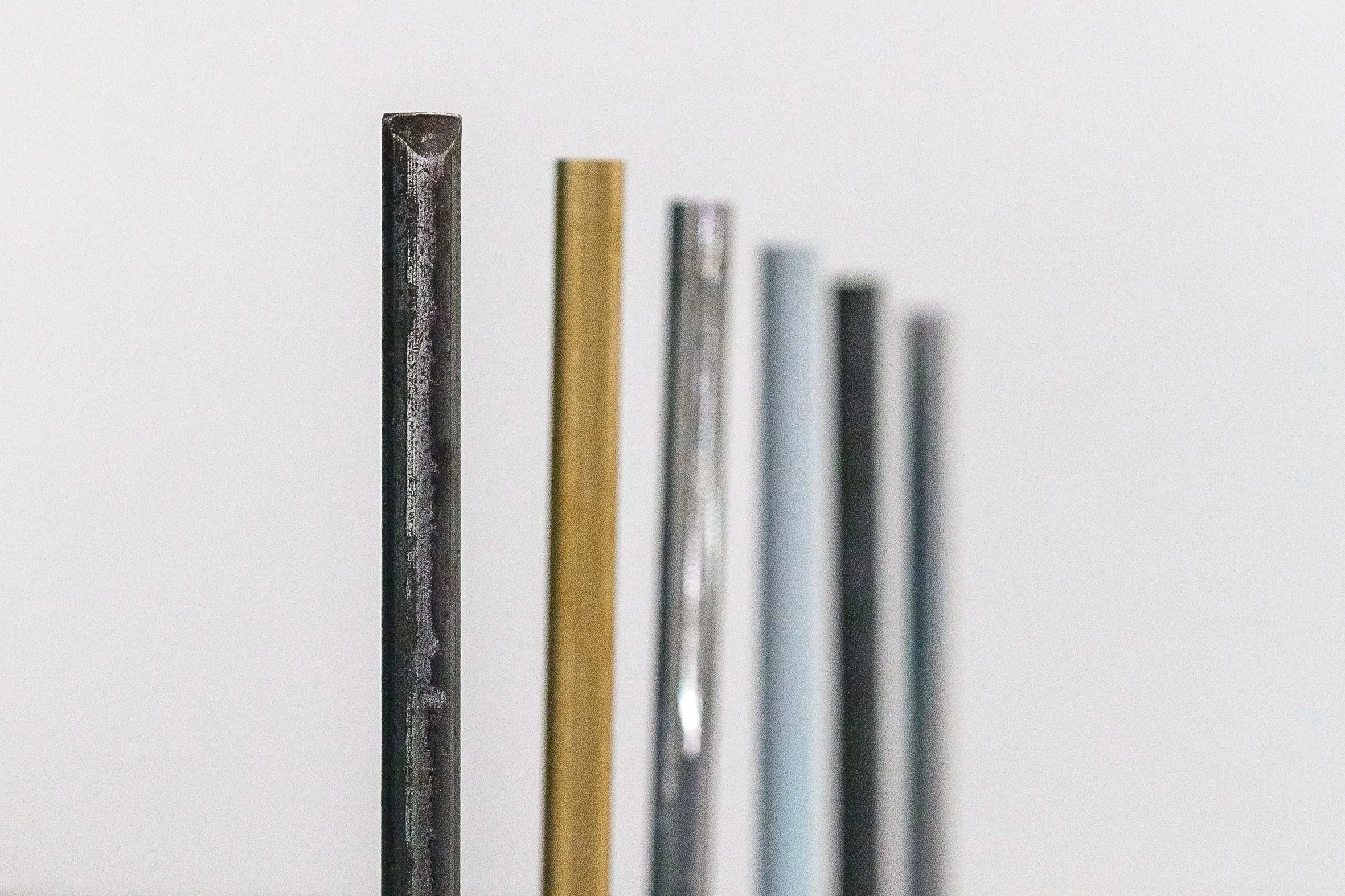
Katherine Corcoran, Portal, 2016, detailed shot. Three objects, dimensions variable. Photography by Document Photography.
ID: A close up of a line of six pipe like objects, that look like they are made from steel, and are coloured from front to back, black, gold, silver, blue, black and grey.
Artist Statement
The world is increasingly experienced through a connected, networked and socially mediated digital interface. The infinite possibility of the virtual exists in direct contrast to the material phenomena that underpins its presence.
Emerging representations of physical space and matter can disrupt conventional understandings of ‘the mental and social ecologies that produce us as subjects’. Through aesthetic and creative production Haining, Corcoran and Clapham attempt to resist existing systems of power. In the making of new forms and alliances (sculptural, digital, personal, professional) we explore the endless spatial plane of the emerging digital as a stage for the production of new subjectivities.
Sara Morawetz
Time is a fluid construct
5 May - 28 May

Time is a fluid construct, 2016, Installation shot. Photography by Document Photography.
ID: There is a white cornered wall that has a black dotted line down the centre, with the black text ‘Tomorrow & Today’ on the left and ‘Today & Yesterday’ on the right.
Artist Statement
Time is a Fluid Construct seeks to examine the philosophical limits of time as a standard measure through a manipulation of the underlying axioms upon which time itself is set. Documenting a pair of performative investigations, this exhibition considers how concepts of time both manifest and dissipate in the face of subversion. The two presented works, How the Stars Stand and 61/60, seek to dispute the assumed universality of time, through various representations of temporal experience as observed on Mars and in the presence of ‘leap’ seconds. In doing so Time is a Fluid Construct asks us to contemplate what do we measure when we measure time?
This work was made in consultation with Dr. Michael Allison of NASA’s Goddard Institute for Space Studies (GISS) and and Dr. Darren Engwirda of the Massachusetts Institute of Technology (MIT).
Benjamin Chadbond, Liz McCrystal, Salote Tawale, Katrin Koenning, Young Sun Han, Jennifer Loeber, Marie Shannon & Nina Röder
The Leftovers
Curated by Talia Smith
2 June - 25 June

The Leftovers, 2016, Installation shot. Photography by Document Photography.
ID: There are a collection of various photo frames. The most visible one to the left has a blonde child’s portrait, with a portrait of a woman on the far back, and abstract images of a blue glove and compact drill in a case.
Exhibition Statement
The Leftovers is a group exhibition that examines the delicate nature of the passing of something or someone. The works question the memories that we hold onto and the histories we try to rebuild when something comes to an end, trying to both honour and make sense of what has happened. Curated by Talia Smith and featuring artists from Australia, New Zealand, Germany and America each artist brings the viewer on a personal journey through grief, existence and acceptance.
Steven Grainger
Displacement Activities
2 June - 25 June

Displacement Activities, 2016, detailed shot. Photography by Document Photography.
ID: There is a bronzed ladder hung on a wall with a pyramid shaped light, projected by a lamp projector in front.
Exhibition Statement
Steven Grainger's work addresses the nature of value, fear, personal responsibility and institutional culpability. In his first international solo exhibition, Grainger uses a legal document, historical and mythological symbols and his own body as the subject and material of his art.
Central to the exhibition is the latest in Grainger's series of Will-pieces that has been ongoing since 2011(whereby the legal document of a will-and-testament is developed as a form of artistic object and process). Each will bequeaths the artist's entire legal estate to a named beneficiary or group of beneficiaries. The wills are legally-binding only for a specified time (usually for the duration of the project or exhibition in which they are shown).
Michelle Cawthorn & Peter Sharp
With M.P Hopkins, Nicola Morton & Ghost Hobo
This is not a solo show
30 June - 1 August, 2016

This is not a solo show, 2016, Installation shot. Photography by Document Photography.
ID: On the back wall, there is a large patterned fabric piece, with the top a red satin colour with pearls placed evenly along it. It is separated with a black dot, and pink and white abstract hanging pieces cascading down from it. Forming out of the fabric is a long piece of white painted wood, sitting on a concrete stone.
Exhibition
It’s Not A Solo Show was conceived out of the desire to explore the dichotomy of our respective practices. As a couple, we understand the intentions behind the work the other does, but we do not inhabit each other’s creative space. Our individual practices are dissimilar in form, material and content but we live together as a creative couple.
Sharp’s practice expresses an external view. Derived from a his lifelong interest in the natural world, his drawings, paintings and sculpture present as a poetic evocation of things we often overlook in the landscape like rocks, leaves and webs. Rather than representing the landscape as a whole, Sharp’s fascination with the minutiae offers an opportunity for an intimate relationship with our natural world.
In contrast, Cawthorn’s practice represented an internal view. Memories and their associations inform her visual practice and are often triggered by the artefacts of her experiences such as a song, a scent or a childhood toy. These resultant juxtapositions were expressed as collages, works on paper and sculpture.
Sharp’s sculptures were made from found timbers and were hand hewn. He does not deny the materiality of the wood; rather this becomes the locus of his aesthetic response. The surfaces reveal his process; chainsaw and drill marks are left as they are made, acrylic washes accentuate the trace. Cawthorn’s works, on the other hand, were made from plywood, bed sheets and clothes of family members and close friends. The tactile and familiar nature of the materials she employs triggered associations with childhood play equipment and cubby houses.
OK YEAH COOL GREAT
Kate Beckingham & Sidney MacMahon
The Delivery
30 June - 1 August, 2016

The Delivery, 2016, Installation shot. Photography by Document Photography.
ID: There is a television screen sitting in the middle of the wall with wires hanging from the bottom of the screen and headphones to the right of it. Dangling above is a pink netted bag with a yellow neon strap hanging on a white rope across the gallery. In the very forefront, a blurred pink t-shirt hangs in space.
Exhibition Statement
In a return to joy, OK YEAH COOL GREAT presented The Delivery. Limited edition art objects were explicitly offered for sale as the artists commented on the tension between value and economics and the potential for success and failure in the art world.
Exploring ideas delivered by Jan Verwoert in his talk at the ICA in April 2015 titled ‘Artists, what is your value?’ OK YEAH COOL GREAT used this exhibition to consider Verwoert’s description of ‘The Delivery’ as part of the value of the artist. The Delivery for Verwoert is about giving the audience what they want via seduction and generosity.
Furthermore, The Delivery explored the value of the artist’s time, labour and actions around making. By offering an exhibition with such explicit commercial and economic intent, OK YEAH COOL GREAT forced the audience to consider the financial realities of studio-based practices as well as questioning the nature of value and desire.
Micheal Riley, Tracey Moffatt, Avril Quaill & Fiona Foley
By a window
Curated by Sîan McIntyre (Verge) & Claire Monneraye (ACP)
4 August - 27 August, 2016

By a window, 2016, Installation shot. Photography by Document Photography.
ID: A close-up shot of a book placed amongst other books and magazines. The title of the book reads "Freedom Ride: A freedom rider remembers" by Ann Curthoys. The cover image contains a black-and-white photograph of young children swimming in the rain. There is a tag at the top of the book cover, with a barcode, indicating that it belongs to the University fo Sydney library. There are pink page markers visible from the top of the book, reading "Freedom Rides: people involved", "Charles Perkins Sydney University", "Decision to do Freedom Rides" and "Beginning of Freedom Rides". Another book next to it also displays a Library barcode and more page markers.
Exhibition Statement
By a window was an exhibition about two photographs, the people who made them and the stories they reveal. This exhibition was also an invitation to explore the history of the areas surrounding the University of Sydney and a platform to highlight some people and organisations that have had the passion and drive to create change locally, nationally and internationally.
Content Warning: Aboriginal and Torres Strait Islander people should be aware that this exhibition contains images, voices and names of people who have passed away.
David Manely
Brutes
1 September - 24 September, 2016

Brutes, 2016, Installation shot. Photography by Document Photography.
ID: On the floor of the gallery there is a wood and cardboard sculpture, about knee height. It is a rectangular box held up by several short wooden legs. The box contains layers of stacked cardboard with a panel of wood that runs vertically down the box, and a small wooden block placed on top of the sculpture.
Exhibition Statement
Brutes was a selection of works from the Ambivalent Structures series as well as more recent work that traced the aftermath of modernity through its attendant buildings and structures, inextricably linked to the violence of war.
Katy Plummer, Kuba Dorabialski, Connie Anthes, Glenn Barkley, Amanda Bromfield, Holly Macdonald, Rachael McCallum, Eloise Rankine, Bev Shroot & Ashley Scott
Stuck In The Mud
Curated by Madeleine Preston
1 September - 24 September, 2016

Stuck In The Mud, 2016, Installation shot. Photography by Document Photography.
ID: The gallery has multiple objects on its walls. On the left hand side of the image, multiple colourful banners on sticks are leaning against a wall. Red lines and dots of fabric are stictched onto them, with tassels hanging from the sticks. Colourful cushions with embroidered assault rifles are hung on the wall between the banners, lower to the ground. The middle wall shows two small circular pieces hung on the wall. The wall to the right contains an open book placed on a shelf with images and text. There is an abstract ceramic piece hanging on the wall beside it, and a plinth in the center of the space with a ceramic sculpture placed on top. The sculpture depicts an abstract figure with disproportionate features. In the right hand corner, there is a CRT monitor that shows a person from the back as they are sitting down .
Exhibition Statement
Curated by Madeleine Preston, Stuck In The Mud presented an archive for a revolution that had already occurred and loosely based on early 20th Century Russian agitprop or agitation propaganda. Mimicking different revolutionary art and craft objects Stuck in the Mud stretched definitions of craft and art.
Stuck in the Mud included ceramic works by Connie Anthes, Glenn Barkley, Amanda Bromfield, Holly Macdonald, Rachael McCallum, Eloise Rankine and Madeleine Preston who were current and past members of the Sydney ceramics studio collective kil-n-it. Also exhibiting were Katy B Plummer with textile works, Ashley Scott with sound works, and Kuba Dorabialski and Bev Shroot with video works. Stuck in the Mud commemorated a revolution of craft vs art, where art won, or did it?
Tim Bruniges, Boris Bagattini & Brooke Stamp
Volumetric
28 September - 6 October, 2016

Volumetric, 2016, Installation shot. Photography by Document Photography.
ID: A woman wearing a black top and silver shorts lies upon a piece of fabric on the floor of the gallery. One arm props her up and the other is raised above her head as she looks up to the ceiling with her eyes closed. Behind her is a drum cymbal, a stage light and a projector on a plinth. A drumstick and a small metal object lies on the floor beside her.
Exhibition Statement
Volumetric was a collaborative development project that occured over a period of ten days in late September between artists Tim Bruniges, Boris Bagattini and Brooke Stamp. Working within a reflexive framework, the artists utilised sound, light and movement to reinterpret the volumetric properties of the gallery space.
In response to the gallery’s asymmetrical architecture, Bruniges developed a perpetual audio feedback composition. Through analysis of extant light, Bagattini worked with the gallery’s incident and reflected light to manipulate, amplify and retransmit new forms using custom software and laser projection. Drawing from an improvisational movement practice, performer and choreographer Brooke Stamp explored sculptural bodily form within the constructed time and space environment of the gallery space.
Verge Awards / SOS SCA
11 October - 22 October, 2016

SOS SCA, 2016, Installation shot. Photography by Document Photography.
ID: The gallery has numerous large red and white banners hanging on the walls. On the right, a sign saying "BVA STAYS" hangs on the wall, above some smaller cardboard signs with various slogans such as "No Move, No Cuts", and "Let SCA Stay" lean against the wall. On the center wall, a large banner with the letters "SOS" is suspended, with a drum placed on the floor beneath it. The drum shows clear sign of use, with a small sticker that says "#SOS SCA" stuck to it. On the right wall, a political poster which states "The University of Sydney is killing its art school" and a cardboard stencil with numerous cutouts of the letter S that have been sprayed with paint are hung on the wall. A plinth with a clipboard and more "#SOS SCA" stickers can be seen in the right corner of the image.
Student Artists
Shortlisted artworks by: Anna Shen, Safari Lee, Jack Godfrey-Baxter, Xan Hardman, Jacques Chevrant-Breton, Mariia Zhuchenko, Jiamei Liu, Michael Sun, Janine Bailey, Andrew Simms, Stephen Burstow
Shortlisted musical compositions by: Anna Shen, Sarah Gaul, Alexis Weaver
Shortlisted literature by: Jess Zlotnick, Tom St John, Edward Furst, Samantha Jonsher, James Holloway, Michael Sun, Katrina Kemp, Jeremy Blum, Izabella Antoniou, Daniel Gunstveit, Sophie Wakefield, Alcina Giang, Shaun Colnan, Nicola Cayless, William Poulos
Ron Adams, Kate Beckingham, Kieran Butler, Lucas Davidson, Daniel Hollier, Richard Kean & Carla Leisch
Modes of Practice
Presented by MOP Projects
3 November - 26 November, 2016

Modes of Practice, 2016, Installation shot. Photography by Document Photography.
ID: On the left wall, there is a large scale painting of text which reads "I am the son and the heir of nothing in particular". The text is in large blocky black letters and does not follow typical punctuation of syntax on the canvas. Next to it, a colourful abstract artwork hangs high on the wall.
Exhibition Statement
Modes of Practice brought together past and present MOP Projects committee members Ron Adams, Kate Beckingham, Kieran Butler, Lucas Davidson, Daniel Hollier, Richard Kean and Carla Liesch in this allied location and timely exhibition. Our mode of practice is our way of thinking about and through making, a process-driven philosophy that is nurtured through the experimental nature of our artist-run-spaces. These artists had worked together before, their object-based and expanded ideas of art-making engage in an ongoing dialogue with each other, and the space in which they exhibited. In collectively discussing this exhibition, the artists had all developed work from significant moments working with MOP Projects as they celebrated the end of an important 14-year Sydney institution.