
Hope floats by Isabella Hone-Saunders, 2026
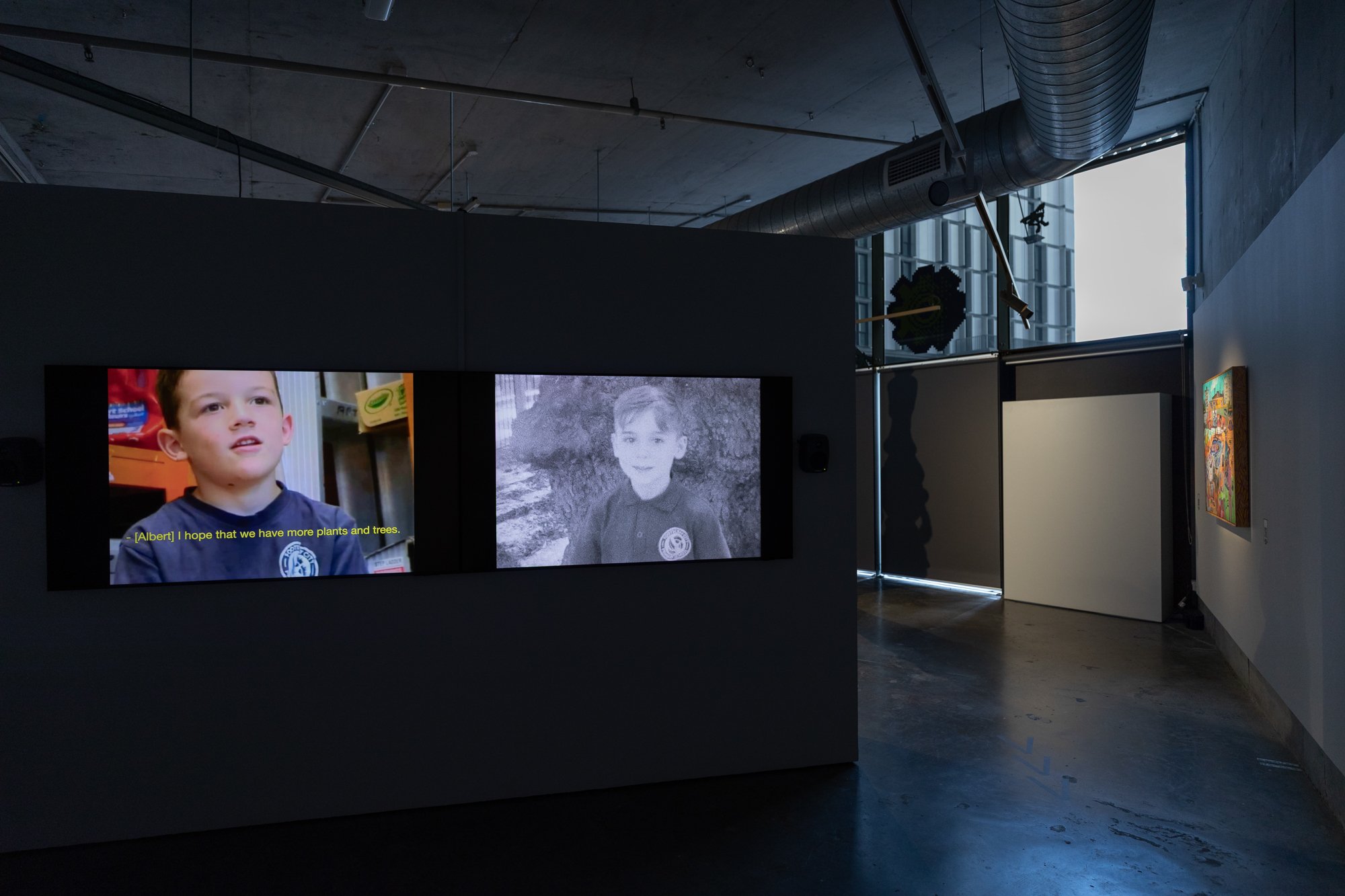
Isabella Hone-Saunders, Hope floats, 2026. Two-channel video work, 15 min 30 sec, colour and black and white, digitised Sony hi8 tape and Super 8. Scored by Daniel Jenatsch. Photography by Jessica Maurer.
Transcript
This artwork is titled Hope floats and was created by Isabella Hone-Saunders. This artwork was finished in 2026. It is a two-channel video artwork, meaning that the artwork consists of two videos displayed on two monitors. The monitors are installed in a landscape orientation, measuring approximately 1.4 metres wide by 80cm high.
The videos are 16 minutes and 22 seconds in duration, and they both run on a loop. The monitors are positioned side-by-side on one wall and approximately 1.5 metres from the ground. Please note that on the far side of this wall, there are two chairs arranged for viewing the video.
Hope floats features interviews with primary school children, highlighting their considerations on hope. In preparation, artist Hone-Saunders worked collaboratively with Footscray City Primary School, building a relationship with the students in Prep to Grade Four.
This artwork features a soundtrack by Daniel Jenatsch. The sound is playing out loud, with the sound being directed towards the area in which the monitors are located. The soundtrack has a hopeful yet sombre tone, with high pitched sounds like whale noises playing throughout the work. The soundtrack is the only audible element of the work - the words that the children are speaking are communicated via closed captioning only. The full transcript of this artwork can be found as a link on the audio description webpage for this work.
The left monitor shows a video of children in school uniforms being interviewed about their hopes for the future. This video is in colour. The children are interviewed in what appears to be the corner of a classroom, sitting on a chair with a shelf of paint supplies behind them. The camera angle during the interviews often starts as a mid-shot and sometimes cuts to a close-up of the children. The camera appears a little bit shaky. In total, there are about 20 students interviewed, some speaking to the camera alone, and others in pairs. A child named Isaac states ‘I hope that there’s more electric cars and I hope I don’t die.’ A child named Georgia says, ‘you need to believe in yourself if you want to have hope, because if you don’t then you probably won’t be able to do something that you actually can do.’ Another child, named Marisa, shares, ‘even though I pretty much know, I hope I’ll get a pet lizard for my birthday.’ The full transcript of the closed captioning for this video can be found here.
On the right monitor, the video is in black and white. The first black and white scene is an empty school ground with a staircase and iron fence which you can see through. Images of the children’s faces who spoke in the other video (on the left) are shown throughout the video. Each video begins as a tight mid shot and zooms slowly into the child’s face until they are captured in a close-up shot. Each child is looking directly into the camera. The children are each positioned in different locations. For example, one is sitting in a tree, another is sitting in front of a fence.
Interspersed within these videos are slow motion videos of children in the playground – some are walking or running, others are playing. There is a grainy effect, like an older style of video, across all of the footage, creating a nostalgic effect.
At certain points within the artwork, both monitors show the same footage at the same time. This footage features the children writing and drawing about hope in a classroom environment.
Hope floats examines the profound potential of hope. Hone-Saunders has been conceptually and research-focused on ‘hope’ as a generative methodology for imagining collective futures. Hone-Saunders comments, ‘my central question of hope lies squarely with the urgent need to assess the relationship between personal and communal wellness in a world of political and ecological anxiety. I believe that hope fuels the action required to enact imaginative strategies.’
Isabella Hone-Saunders is a curator, arts worker and artist, born on Kaurna Country/Adelaide, now living in Naarm/Melbourne. Their broader practice is concentrated on amplifying community and socially-engaged practices and supporting artists in taking creative risks. Currently they hold the role of Assistant Curator, Art Museums, the University of Melbourne. Formerly working as the Director of Seventh Gallery, Hone-Saunders has also held curatorial positions at the Australian Centre for the Moving Image (ACMI) and at the Australian Centre for Contemporary Art (ACCA). Hone-Saunders has a Master of Art Curatorship from the University of Melbourne and is a current PhD candidate in Curatorial Practice at Monash University.