
The snail by Madi Feist, 2026
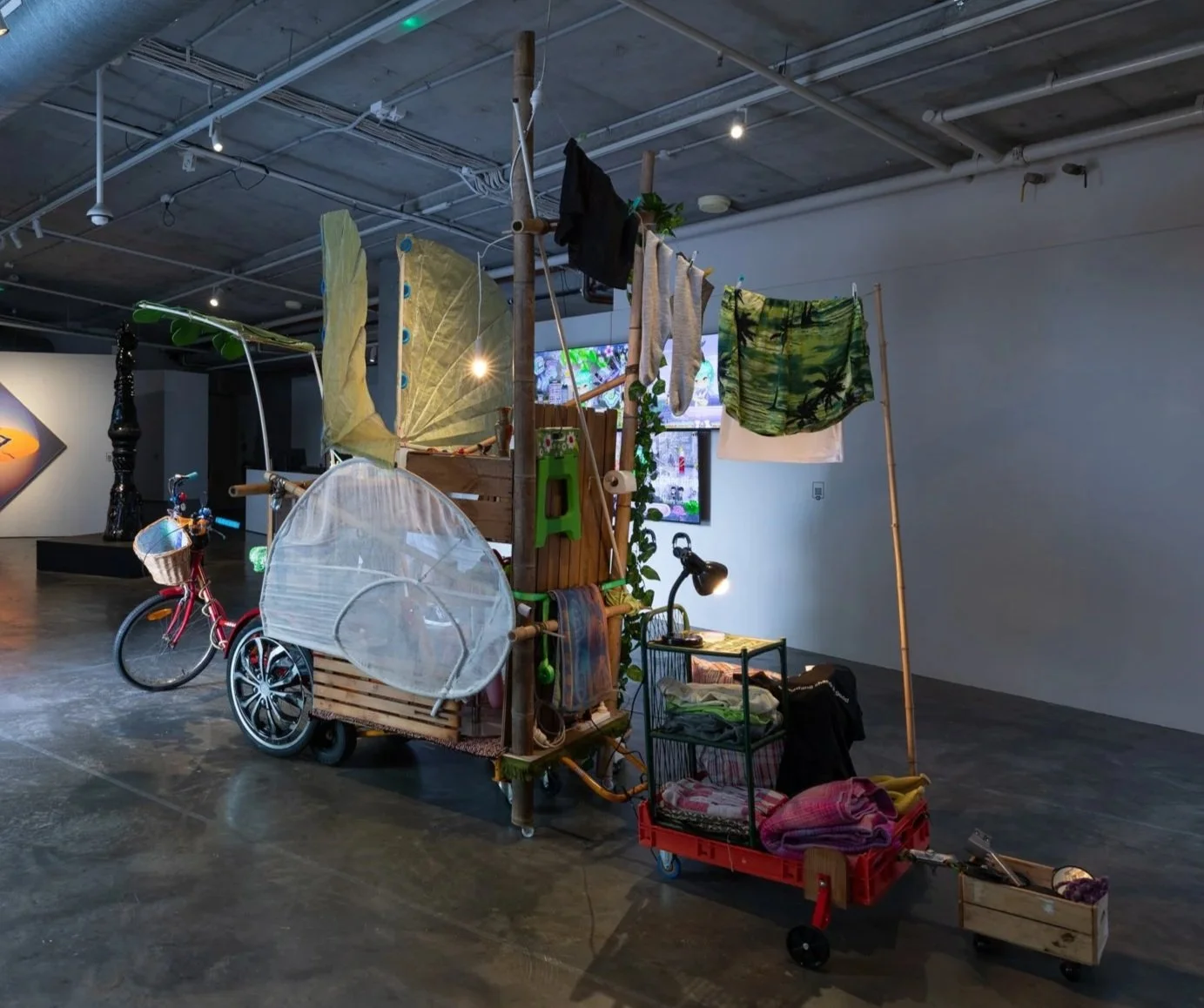
Madi Feist, The Snail, 2026, INDI Rambler tricycle, found furniture and household objects, wood, metal hardware, bamboo, rachet straps, plants, pvc pipe, rope, assorted textiles, castor wheels, plastic, lamps, metal, shells, dimensions variable. Photography by Jessica Maurer.
Transcript
The title of this artwork is The Snail by Madi Feist. It is an installation made of found objects. It measures approximately 3 metres high by 4.7 metres wide by 2.2 metres deep and can be viewed from all sides.
Starting from the right and working towards the left, the profile of the installation consists of a red adult tricycle. The tricycle has one front wheel and two back wheels. Across the body of the bike, there are the words ‘ Indi Rambler.’ At the front of the bike, there is a woven basket, and on the handlebars, there is a few different bells and horns, as well as a pink butterfly hair clip. On one of the bells, there is a circular white sticker which says ‘I heart my bike’ in black lettering.
On the back of the bike, between the wheels, there is a dark wooden shelving unit with four legs. It is about 1 metre high, and 30 centimetres wide and deep, and has three horizontal shelves.
On the shelves, there are homely objects, including a cup, plate, knife, fork and spoon. Tied to the top of the shelf, there is a piece of bamboo, approximately 1 metre wide and 10 centimetres deep.
Attached to the shelving unit, there are vertical poles reaching about 2 metres high before they curve towards the handlebars. Fake banana leaves are placed above to give coverage to the person riding the tricycle.
Supported by other poles, slightly leaning out from both sides of the tricycle are bright yellow shower curtains, each folded to look like an oversized hand fan. To the left of the fan and going towards the back of the tricycle, there is also a spiral shape, made of a curved piece of plastic, which is hanging off the side of the installation.
Behind the bike, there is a bright yellow hand trolley which is laying parallel to the ground like it's being pulled by the tricycle, with the small lip pointing up. The bottom of the trolley is facing the bike. The trolley has four wheels with the two larger wheels closest to the tricycle. On top of the hand trolley, there is a thin square piece of wood, about 1 metre by 1 metre in size. There are two large pieces of bamboo, each just shorter than 3 metres high, standing in an upright position in the back left and right corner of the wood. There are vertical planks of wood attached between them, creating a backing for the tricycle. Smaller pieces of bamboo are attached at the sides of these bamboo pieces and are connected to the front two metal poles.
Attached to one side of the wooden platform is a shorter triangular wooden platform with extra support wheels, like training wheels.
At the end of this sculpture, there is a red bread crate with two wheels at the back. Behind this crate, there is another, smaller, crate made out of wood.
Of this particular work, Madi says, ‘The Snail imagines a fictional character living off their bicycle in an imagined future, where the bike functions as both transport and home. Everything the character needs is carried in one place, reflecting a nomadic way of living shaped by attachment, sentimentality, and survival. Drawing on posthuman ideas, the work suggests that identity extends beyond the body into the objects and materials we carry…The sculpture’s bright colours and layered adornments are inspired by Filipino Jeepneys, repurposed vehicles known for their inventive modifications and cultural pride. The accumulation of objects reflects both necessity and excess, highlighting the tension between survival, comfort, and attachment in contemporary life. The Snail playfully offers slowness and adaptability as ways to move through uncertain futures.’
Working primarily across sculpture and assemblage, Madi Feist is a multidisciplinary artist living and working on Gadigal Land. Her practice centres on collecting discarded materials, peculiar objects, or mundane remnants of daily life. She transforms this ‘junk’ into works that playfully dissect how consumerism shapes the way she observes the world. Drawing on her Italian and Filipino heritage, Feist constructs humorous and symbolic narratives expressed through her sculptures, with references that range from ancient mythology to personal anecdotes. In 2025, Feist was awarded Gosford Regional Gallery’s Emerging Art Prize, and was a finalist in Burwood Art Prize and Hazelhurst Art On Paper Award. She has exhibited at Puzzle Gallery, China Heights Gallery, and Passport Gallery. In 2021, she completed a Master of Fine Arts from the National Art School.