
Gong Gong’s Coins, 2026
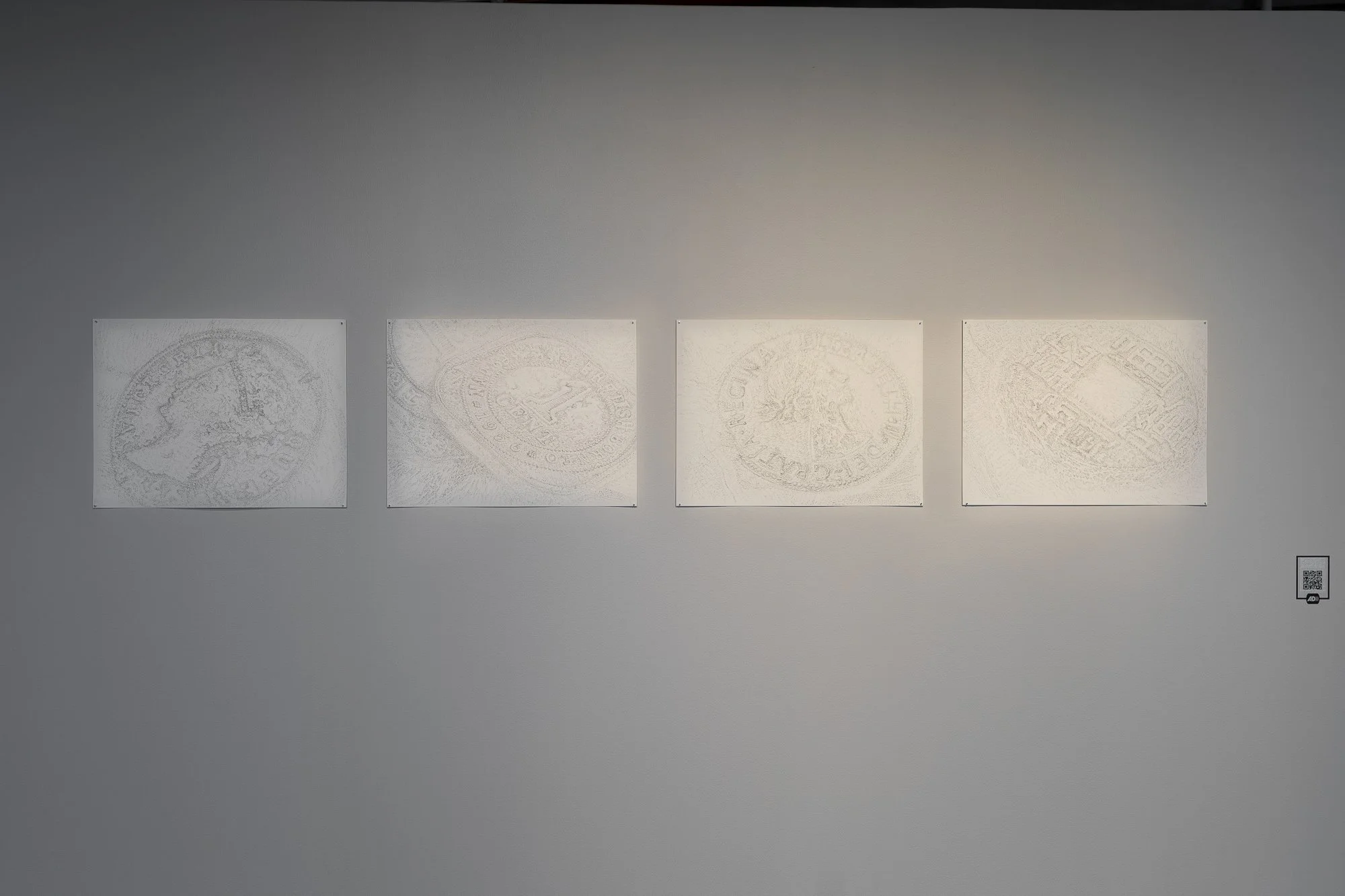
Cindy Yuen-Zhe Chen, Gong Gong’s Coins, 2026, pen on watercolour paper, 46 x 61cm. Photography by Jessica Maurer.
Transcript
Gong Gong’s Coins, by Cindy Chen, 2026, is comprised of 6 drawings in a series with each drawing measuring 46 centimetres high by 61 centimetres wide and made with pen on Arches watercolour paper.
Entering the gallery, two of the drawings are positioned on the short wall on the right next to each other. The other four drawings are located on the wall at the back-left of the gallery and are displayed side-by-side in a single row.
The first work depicts a coin, circular, and is positioned slightly left of centre with the base of the coin touching the bottom edge. Dots and etchings decorate the circumference of the coin depicting a slightly rough edge. Following the curvature of the coin on the right-hand side and in capital letters is the word ‘queen’ while continuing around to the left-hand side and, also in capital letters, is the word ‘Victoria.’ In the centre of the coin is the profile of a woman's head, facing to the left and looking slightly up. She is wearing a crown. Extending off the top of the coin are loosely drawn lines leaning slightly to the right as if the coin was in movement.
The second work shows a coin, mostly positioned in the bottom left-hand corner touching both the bottom and left-hand side edges. The shape of this coin is a diamond with soft edges which reach out towards the right and towards the top but not touching. In the centre of the coin is written ‘1 CENT’ with numerical ‘one’ being used and the word ‘CENT’ in capital letters.
Surrounding the monetary value description is a circle and written in the circle is currency ‘Malaya’ in capital letters and the date 1945. Continuing up to the top right corner of the work is the second coin. This is mostly visible, but the image has surpassed the edges. This coin appears upside down with only part of the ‘1 cent’ visible and part of a word that could say ‘commissioned.’ It also has the date ‘1941’ visible and upside down. The drawing of the second coin appears to be quite faded around the edges.
The third work depicts a large square coin positioned like a diamond with another coin behind, obscured by the first coin which dominates the majority of the right-hand side. In the centre of this coin the word Borneo appears in capital letters along with the numbers 1956. There is a lot of etching detail on the surface of the coins, like they are well-worn and aged. The drawing is focused in the centre and becomes faded and lighter as the image spreads to the edges of the work, especially on the top right.
The fourth work depicts a round coin with a square centre. The coin is positioned slightly to the right with some space at the bottom edge and left-hand side of the artwork. Chinese characters which mean ‘Qianlong,’ who is an Emperor from the 18th century, as well as the name of the currency of the time, is written on the coins’ surface along with dots and etchings suggesting that perhaps the coin is quite old. In the background, behind the coin, the artist was trying to replicate the lines on her hands, with it also turning out to look like fields of farmlands or rice paddies.
The fifth work has a round coin drawn just right of centre with none of the coin touching the edges of the artwork. Following the curvature of the coin, starting on the left and curving around to the right, are the words ‘Regina Elizabeth,’ all in capital letters. Along the bottom of the coin's curvature, also in capital letters, are the words ‘dei gratia.’ In the centre of the coin is the profile of a young Queen Elizabeth - bust, shoulders, neck and head are all visible and facing to the right. The surface of the coin seems to be dotted and appears slightly blemished. Behind the coin, in the background are many small loosely drawn lines and squiggles with a few squares all flowing easily in a few directions.
In the sixth and last work is a single round coin positioned off centre to the left. The coin only touches the left edge and bottom edge of the work. The coin is rotated and is displayed sideways. In the centre of the coin is the number 50 with the word ‘sent’ written in capital letters below. The words ‘STRAITS SETTLMENET’ in capitals run around the top curvature of the coin. The last two letters of the word settlement are not distinguishable and fade out and run off the bottom edge. And the words ‘HALF DOLLAR’ and date ‘1920’ run along the bottom curvature of the coin. Due to the age of the coin, it is mottled in appearance. Behind the coin, in the background, are many small, loosely drawn lines and squiggles, mainly flowing from bottom left to top right.
Of this work, Chen says, ‘six drawings of my maternal grandfather’s coins trace my family’s trajectory of migration from Qing Dynasty China, through phases of British colonisation in Malaysia, including Straits Settlements, British Borneo and post WWII Federation of Malaya, and ending in Australia. The diffuse, stippled marks of these drawings evoke the histories and landscapes etched into surfaces that were once the locus of many hands exchanging, bargaining and negotiating for goods, land and power.’
Penang - where the Chen’s grandparents, mother and Chen, was born - was Britain’s first settlement in Southeast Asia and a significant locus of communication, exchange and trade. The cosmopolitan nature of his hometown allowed Chen’s grandfather to create a cultural legacy through his coin collection. The coins chosen for these drawings mark key moments in history that were lived by Chen’s parents, grandparents and ancestors, allowing her to archive memory through drawing.