
Ah Po’s Sarong Kebaya Triptych 2, 2026
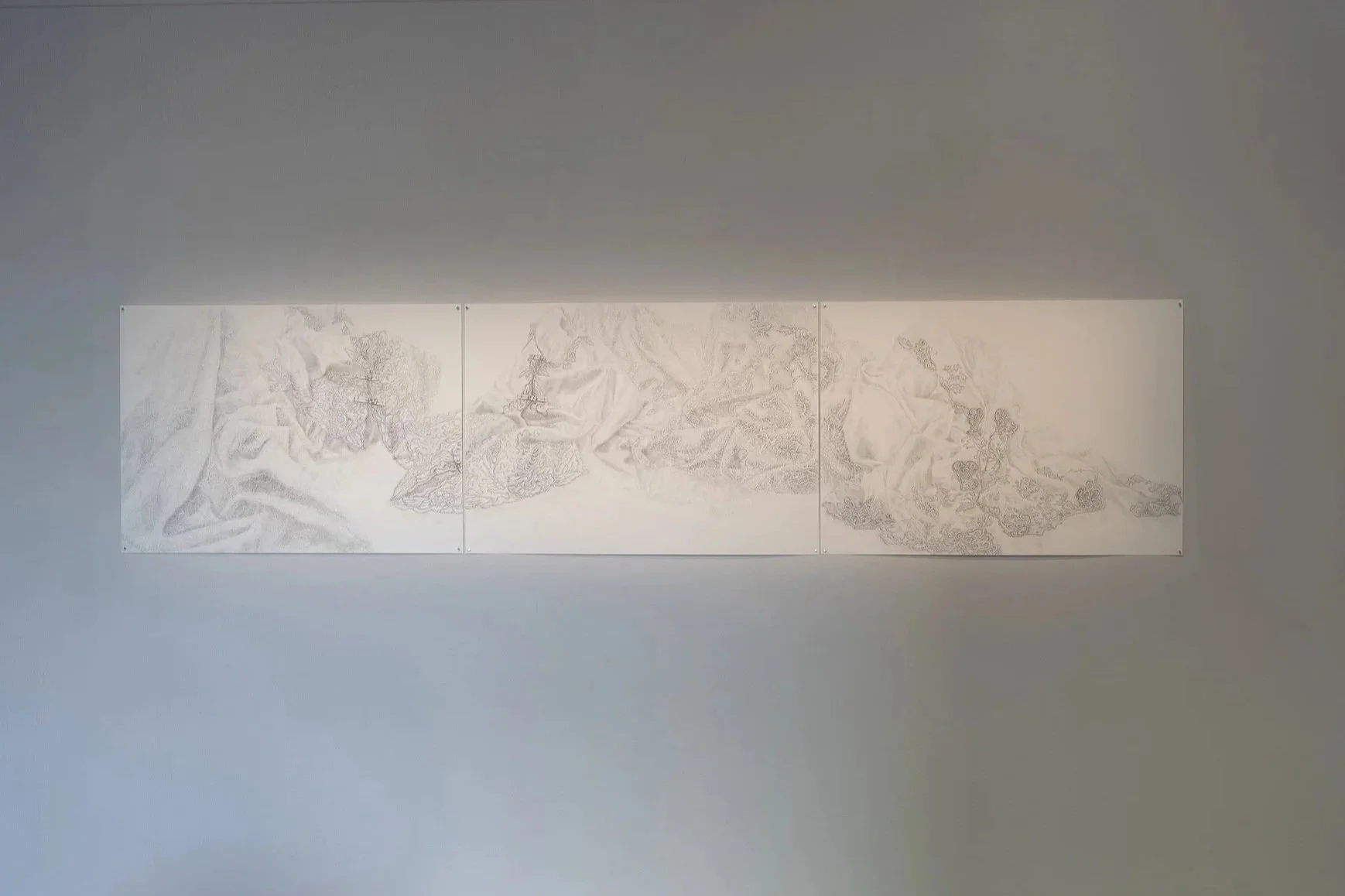
Cindy Yuen-Zhe Chen, Ah Po’s Sarong Kebaya Triptych 2, 2026, ink on watercolour paper, 59.4 x 84.1 cm. Photography by Jessica Maurer.
Transcript
Ah Po’s Sarong Kebaya Triptych 2, by Cindy Chen, 2026, is a black and white triptych art piece comprised of three panels each measuring 59.4cm high by 84.1cm wide and is made with Chinese and Japanese ink and pen on Arches watercolour paper with all three panels displayed in landscape with an overall measurement of 59.4 cm high by 2.53 m wide.
Starting from left to right, the first panel in this triptych depicts a scene of two mountains.
On the left are two mountains positioned close together that reach from the bottom edge of the work with their peaks touching the top edge. Both mountains are made of fabric containing outlines of large flowers and leaves however the second has darker outlines.
In the second panel of the triptych, the way that the fabric of the garments are folded depicts two mountains. The fabric continues from the first panel into the second at a mid-height. This mountain has a vertical line of embroidery running down the centre from top to bottom. The same detail of embroidery runs horizontally at the bottom, creating the base of the mountain. The second mountain contains embroidery made up of vines and leaves as well as tiny flowers. The mountain is right of centre and up towards the right-hand corner.
In the third panel of the triptych, the mountain being shown isn't quite as tall and the fabric is like a delicate lace material. Delicate folds of lacey fabric create the smooth outline of the mountain. The mountain starts from the top left and gently slopes down to the bottom right corner. Running down the centre of the mountain are embroidered leaves and vines of the fabric being used. The embroidery has two butterflies with little antennae. Another line of embroidery running from left to right creates the bottom edge of the mountain. This embroidered line consists of leaves on a vine and clusters of five-petaled flowers, some of which seem like they are floating away.
Cindy Chen says about her work, ‘This three‑panel drawing of my grandmother’s Peranakan Nyonya kebaya blouses and batik sarongs is arranged like traditional Chinese shanshui (mountain–water) landscape paintings, connecting the work to my cultural heritage. My grandmother, Ah Po, lived between cultures. She balanced her Chinese roots with the diasporic identities that developed in Penang under British rule. Born to Chinese migrants during the British Straits Settlements period, she chose to wear Peranakan Nyonya kebaya blouses and sarongs to show solidarity with local Peranakan (Chinese–Malay) culture and communities. Her cultural dress and identity were fluid, shifting between Chinese and Peranakan. Her most modern kebaya even includes a Chinese pankou knot, blending both cultures further.
The cut and embroidery of the kebaya, along with the floral patterns of the batik sarongs, show both European and Chinese influences. These designs reveal centuries of cultural exchange shaped by trade and by Dutch and British colonisation. Out of this long history came hybrid textiles and complex cultural identities. Made with Chinese ink and pen, these drawings also reflect my training in Western art practices, expressing the ongoing blending of cultures and hybridity that continues in my work today.’